
One man has reformulated the primordial soup, opening countless possibilities as he keeps the secret recipe to himself. It animates his robots, who swarm into industry and build lives of their own. It enlightens the animals, who are granted citizenship! It turns humans into indestructible floating heads pondering the universe.
The tributaries of revolutionizing soup converge in Iron Baltimore, city of futures bright and dim, where lives the world’s only hyperdiamond manufacturer, the artist known as Al Grand whose own invention, when loaded into a popgun, can destroy a robot’s crystal brain in a single blow. But he doesn’t sell, and he won’t tell. Everyone’s got it out for him, and one of them has broken in and left a slimy gift in his apartment…
Throw a Monkey Wrench is the first novel in a Wizard-of-Ozian dieselpunk series of five!
(estimated reading time: 1 hour, 12 minutes)
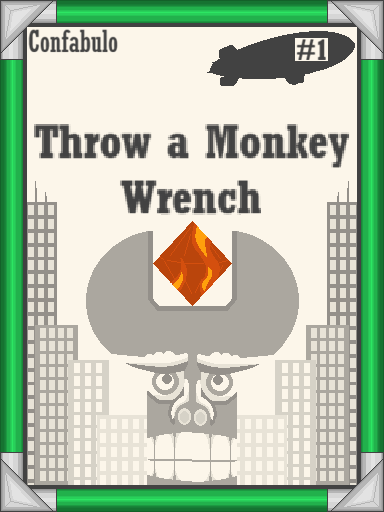
Confabulo
Throw a Monkey Wrench
by
Blaine Arcade
Dress Up with Nowhere to Go
Figures so unlike their lazy scarecrow cousins were strewn across the half-planted fields. Rusty and plain, riveted at left and right, they were bent and frozen mid-labors with hoes, spades, rakes, and watering cans. Round eyes of ribbed ochre glass were dark as the night, poised to borrow the day.
The first rays of morning crested a distant hill, shot into their midst and struck one of the figures on the chest. A stream resumed, as the watering can they held tilted imperceptibly. More light fired across the land, found purchase in their pitted metal and nesting rust. A hoe struck. A rake dragged.
As seeds dropped into divots squeaking steps made more mere feet away. The metal workers came to life, no need for breakfast or stretches. Not a single dream had broken the sequence of their tasks, as their minds could not take them anywhere without their permission or his.
For them it was as if the night had never occurred, as if stillness never occurred. Their entire existence was active experience, perpetual transportation of body, thought, and emotion, caught in currents that required adaptation. When the currents slowed so did they, and when the currents sped they made history much faster than humans were used to.
The morning didn’t stop there; it kept on out of the farmlands where things only grew yea high and on to the city where they grew until the tallest one toppled. Dawn’s artillery on those walls of glass, concrete, brick, iron, and brass was weaker than breath, for this was Iron Baltimore. Its industry was moved by figures well-adapted, ever-present. One fed the other. The leaking weaknesses of previous perpetual motion machines were patched by the constant influx of human demand, of their mean-spirited and flirtatious pushing, and of their emanating incandescent body heat, like blankets tossed out of windows drifting to the street. Iron Baltimore was swaddled with energy.
As such its figures almost never stopped at night. There was no night, not without direct need of the sun. Anything might feed them its energy, it had only be nearby in sufficient amounts. Standing next to a passing train could fuel them, both from the gust it generated and the rattle they felt in their feet.
Some of it was heat, most of the rest vibrations, even those that were just urban noise. A honking horn streaking by could get a few steps out of them, or a honking man for that matter. A good slap on the back gave even more. One’s motion in proximity to another was fuel too, with diminishing effect as it diffused along the chain.
The entire city, grown south out of old Baltimore like an amoeba spilling its electrified guts, thrummed with typical flesh-and blood-people, the less typical quartz and metal figures, the uncommon type of animal that lived there instead of infesting it, and those who weren’t right in the head but who were light in it, going about their own inscrutable business above and between the skyscrapers, forcing those with doggybacks to veer out of the way.
A closer look, across a few hours, made clear that some distinctions could be drawn; there was a spectrum to this mud puddle thick with fool’s gold, cat hair, and lucky twists of copper wire. Certain peoples were better and worse at flowing across certain topological gradients, and when pointed out on a map you would call them neighborhoods even if the map didn’t officially name them. They were the kind of names you had to scribble in the alley margins with a pencil.
You would see the most of the figures, the Dustrious, in the Assembly Line, the poor district full of factories and warehouses, dingiest yet most brightly lit in the evenings so those who didn’t sleep had light to operate by from the streetlamps, neon sign borders, and even iron-caged bulbs wherever they would fit: bench corners, taking the place of mailbox flags, flagpole toppers too, and as balustrade balls for the stairs of the few buildings nice enough to have them out front.
Then squeezed in next to each other you had the Connections and the Zoo, with the former housing all the operators of the various rotio services and their switchboard banks topped with broadcasting towers thick enough to be called a forest, though you’d be deaf to all the bird song and squawking without a radio tuned to the right station or a rotio to your ear.
The Zoo was for the birds themselves, and all the other animals, no surprise there. Rats and pigeons and gulls and flies were everywhere in Iron Baltimore, but only a few of them paid rent. Veteran veterinarians lived there as well, to keep a close eye on their patients who always seemed to have an absent eye on the Wilderness War, though it was over, dead, and lost. The vet-vets had promised their patients they weren’t yet.
Last was the Ice Fields, glittering with glass and genuine diamond plating. All the reflections were yet more fuel for the Dustrious, but you saw the least of them there, scared off by the very deliberate implications of painting your storefront with a coat of diamond dust. Those who had diamonds to spare were happy to plant one in a dusty’s bucket head.
Diamond fabrication and trade was the business in the Fields, lucrative and luxurious, for purposes as plentiful as the stones themselves, including but not limited to jewelry, industrial and scientific equipment, and of course, popguns. How else would you get your diamond back from out of a stubborn bucket head?
The morning looked best there, assuming it didn’t blind you. No building was more radiant in those dawn rays than the Ice Palace, an apartment complex with shopping on the first five floors and those who owned the shopping, and most of the rest of Iron Baltimore, living in the eighty-five floors above that.
Painted ivory white, bold titanium, and daring diamond, every face and facet and window was intensely lit during one particularly striking moment every morning, utterly blinding to everyone outside who looked its way, like looking upon the face of a god.
One of that god’s pores was darkened that morning, owing to the open window of a fortieth floor apartment. Eager light invaded, hardly knowing what to do with itself now that it had infiltrated the deflecting labyrinth of the Ice Palace. It struck dumb on the first sight in its way, making it the brightest object in the place since all the bulbs weren’t switched back on yet.
A chair had been pulled out from the dining table and stranded in the space between rooms. Draped over its forest green upholstery and gold button lining was a cocktail dress, though it hadn’t always been one. Rough modifications indicated a severe stripping down and shorting; something much older and more conservative had been altered so its wearer could actually have a good time.
Having that good time did come with hazards of course, like spilling a drink, which also appeared to have happened. A vibrant sticky residue was all over the garment, spilling out of the collar onto the chair’s cushion, shooting out of the sleeves to run down the wooden legs, and cascading out the bottom.
Curiously, most of it was actually inside the dress, as if the drink had been consumed first and then spilled. Really there was no explaining it, not with the information available to him as he shuffled, yawning, from his kitchen to his sitting room with a fine tin cup of steaming coffee in hand.
He’d passed the chair once already, on his way to make the coffee, and only under its rousing effect on his peripheral vision, and with the help of the morning’s light, did he take notice and stop to examine it.
Aloysius Grandstand had lived in the Ice Palace for over five years now, had fabricated diamonds and their betters even longer than that. He’d bought the dining table and the ten chairs that came with it. What he hadn’t done was pull one out. Nor had he draped a dress over it. Or spilled a drink down the collar.
Stranger still, he did not own any women’s clothing. There was not a woman in his life at that moment who would’ve been in any sort of position to take off that dress inside his apartment, after soiling it, and forget about it on its impromptu drying rack.
Accordingly, Al slowly circled it, sipping his coffee to boost his brainpower. Getting between it and the window didn’t make it disappear, so it couldn’t be a trick of the light. He looked around for the woman he assumed had to be responsible, found nobody. Had he gotten drunk, convinced a woman his apartment was more impressive than his slipshod demeanor, and made such a mess of things that she’d left after disrobing and not returned?
No, because he didn’t have a hangover. Burglars then. Anti-burglars, the fiends. They’d broken in while he slept, deposited the goods, and retreated, having completely gotten away without it. Al went to his door and jiggled the knob. Still locked. He undid the diamond deadbolt and the diamond chain. Pulled it open.
“Mr. Grandstand!” an energized face with a trim mustache and teeth made for chewing gum said just over the threshold, hand poised to knock. “Did you hear me coming?”
“Who are you?” There was something leather in the man’s raised hand, and it fell open in response: a gold badge with diamond detailing. Al rolled his eyes and grumble-sighed. He should’ve guessed from the trench coat and hat getup, even with the unusual navy color and white lapels, that he was dealing with a gumshoe. In the Ice Fields the coppers were too fancy to leave any gum there of course, scraping it off and leaving only a heel.
“Detective Leonid Caliber,” the slightly younger and much more wired man introduced, taking off his hat and running his other hand through his wavy blond hair. “You can call me Leo.”
“And you can call me Grand if it gets you off my doorstep a syllable sooner.”
“I’m afraid this is a very serious matter Mr. Grand. Down at the precinct we received an anonymous tip that a murder was committed last night, in apartment 433 of the Ice Palace, 16 Frankenbaum Street.” They both glanced at the number on Al’s door, both of its threes following its single four.
“You’ve got the wrong correct address,” Al tried, too wrapped up in his fluffy sleeping robe to say it threateningly.
“Our meeting is certainly not a coincidence. It was going to happen eventually. Even our tourists know your name Mr. Grand; some of them wouldn’t be here if they didn’t. I hoped our inevitable meeting would occur under more favorable circumstances. I’d like to commission you. Look at this sorry thing.”
He pulled out a gun from his shoulder holster and held it in profile. Al didn’t flinch, never flinched for shoddy workmanship. The barrel was only twice the size of a lead shooter, which was on the smaller side for a popper. Its diamond plug was cylindrical, cloudy, scratched to hell, and thirty percent maker’s mark by surface area.
“I am sorry.” Having given his condolences, Al prepared to close the door.
“Ah, Mr. Grand. The murder?”
“Do you have a warrant?”
“I have warranted concern. What harm is there in letting me take a peek? I’ve seen enough crime scenes to know ’em when I see ’em.” Al’s breath jetted out his nose, cooled his already suffering coffee. Iron Baltimore’s police hardly had anything to do, given that if they tried to do it in a dusty part of the town they’d disappear and reappear partitioned inside a tackle box. Their position was significantly ornamental, a demonstration that the Maryland government, and by extension that of the United States, was still technically in control of the place. Not Leo though. Most officers dreamed of only one thing, clearing irritating legal blockages for the wealthier denizens, often then transitioning into private security and bodyguarding. Al guessed Leo would come back with a warrant, and that he would think doing so was a favor.
“Listen, Leo, something is going on. I’ve just gotten out of bed, after a long day of murdering absolutely nobody, to find that someone’s been in my apartment, causing mischief. Now I’ll let you in, on the condition that you’re here to investigate this vandalism, not some cockamamie murder charge.”
“You have my word,” Detective Caliber said, putting away his polished but pathetic pop pistol so his hand could cover his heart in a swear. Al shuffled to the side, ushering him in. “Wowie zowie.” It wasn’t just the high ceiling that got the exclamation out of him; there was the marble counter, the electric fireplace with the adjustable flame color, and the sand garden of magnetized iron filings hanging on the wall, hand rake dangling from its incomplete spiral pattern. There were plenty of toys for the sophisticated man of mechanical mind, all of which had seen heavy use shortly after their acquisition and then never again.
One wall, opposite the open window, was plain red brick, shipped from his old apartment in his old city, to remind him life hadn’t always been diamonds. Detective Caliber scampered back and forth to check every open room, passing the well-dressed chair twice without taking notice.
“You don’t keep it on display?” he asked from the kitchen while Al was glued three feet from the suspicious seat. Leo could only mean one thing, but Al always made sure to teach people not to ask.
“What?”
“The Safari Collection!”
“No.”
“But is it here?”
“You’re here to see this,” Al reminded, stomping his slipper so it was loud enough to tap like a regular shoe. A moment later Leo glided in beside him and quietly stared at it until he took off his hat again. “What are you doing that for?”
“Respect for the dead.”
“Nobody is dead you knucklehead. That’s your evidence of criminal mischief right there. Somebody broke in here while I was sleeping and put it there.”
“Now why would somebody go and do a thing like that?”
“I think the word mischief covers it. So go find them and ask them why yourself. And ask what they got all over my chair.” Caliber stepped forward and leaned to examine the residue with eye and nose.
“Could be decomposed corpse goo,” he said in his best attempt at technical language. “Or waxy runoff from whatever you used to dissolve the body. Fats that didn’t want to be soluble, you know. The gristle.”
“Except there wasn’t a body,” Al protested louder now that his cup was empty. “I came home last night, alone, with nothing out of place. Then some demented party, whose motive is the job of a detective of a certain caliber, snuck in here and mischievously installed some kind of grotesque sculpture. Now go get ’em!”
“First I’ve got to get the evidence,” Leo said, digging around in his coat pockets once more, this time for a rubber bag and pair of tweezers. “You oughta see the lab we’ve got now Mr. Grand, completely state of the art. Threat detection, chemical analysis, reference books for the make and model of every dusty and machine out there. Our eggheads will take a crack at this stuff and find out every ingredient.” He fumbled with the bag’s resealable opening. “Now how do I… damn it ripped. Got another one around here somewhere. They said to squeeze the air out…”
“To prevent further contamination,” some further contamination of Al’s apartment said from beside him, finally getting him to flinch. There was a sudden woman standing there, and she was actually described as sudden much of the time, given that she always spoke before being spoken to. To find the truth you had to frame it first.
“Who let you in!?” Al barked.
“The door was open,” she answered, pointing with her poised pen over her shoulder as she clutched a large paper pad. Al whipped back to Leo, who was squinting in the hopes of turning his eyes into a microscope and seeing a minuscule blob of evidence on his tweezers.
“You didn’t close it?”
“Why would I?” the detective muttered, diving back in for more sticky, stretchy, shiny residue.
“To keep Poe’s Stylus out of my business,” was Al’s retort. With another sigh he looked at her, hoping to see someone, anyone, as disheveled as himself or the gooey gown. Alas, the woman he recognized as Vanity Press, lead society reporter for the Stylus, was her usual composed self. If there had been a loose thread out of place she would’ve tugged it long ago and found the scandal of the century. She was a thin weapon of a person, something you could slip under a door and get stuck in a pacing foot. Her head always had a little sway as she analyzed different angles of faces for beads of sweat. Whenever someone pulled a jacket over their face and ran to avoid the reporters they had a decent chance of seeing Vanity down there already, checking to see if their belt was too loose.
“When the world’s only fabricator of hyperdiamonds commits murder at the top of Iron Baltimore, that’s everybody’s business,” Vanity claimed, eyes alight with appetite instead of horror. She too was wrapped in a snappy coat, lilac and cream, and all buttoned up when the September of 1935 hadn’t turned cold yet, as if they were in cahoots to make Al look bad with his robe’s cloth belt, which was in fact very loose.
“Somebody tipped you off to this phony killing too?” the tenant said gruffly, rubbing his forehead. “Maybe they had a rotio to each ear, talking to both of you to save time.”
“Is that your victim’s outfit?” she asked without missing a step, actually taking several more toward her own investigation. Al shuffled to the side to block her.
“You’re trespassing. Detective Caliber, there’s a criminal right behind you. Do you want to maybe turn around and do something about it?”
“Rats!” Leo blurted, shaking his hand. “I touched some.” He did then turn around, only incidentally, showing the reporter that he, against procedure, wore a baggy like a glove as he squeezed to wipe the evidence off his fingers and into it before sealing. “Ms. Press, I’m afraid I’ll have to ask you to leave, unless of course I can deputize you into assisting me. You’ve been to a few parties here, haven’t you?”
“Back when Mr. Grandstand was letting people in,” she confirmed, scolding him with just a tilt of her short stiff hair. “It’s been two years since he so much as licked an invitation envelope.”
“Ran out of spit,” Al spat.
“Try ink,” she quipped. “I’ve never run out.”
“Did you happen to use any of it to write about the Safari Collection?” the detective asked. “I was hoping to see it.”
“You mean he didn’t show you!?” she gasped sarcastically, already whirling around and marching to Al’s reconstructed red brick wall. He moved to stop her, but Leo squeezed between them and babbled something about not touching the scene of the crime. By the time his distraction was finished Vanity had pressed the upper leftmost brick five times.
A toothed line vertically bisecting the bricks opened as a hidden mechanism turned the two sections of wall into sliding doors. Behind them were five cylindrical stands, against a backdrop of emerald leaves on a flat wire tree. Three of them were empty. On the remaining two stood the jewels too great for any crown, too hot for any market, almost too grand for their stands.
Hyperdiamonds. Their color separated them from their clear cousins, as these were warmed to a shade between an amber spirit and a milky flame. Sweet and luscious, smooth and flawless, the pair of hyperdiamonds were just small enough at the base to fit into a standard popgun, about twice the size of the cruddy plug in Leo’s pistol.
Each was contiguously topped by its own cut bust of an animal: an elephant and a mouse. Apparently Al thought there was some truth to the idea of elephants being frightened of mice, as they stood on the ends as far from each other as possible.
“Rats in spats!” Detective Leo uttered, leaning in closer than he did for the possibly melted cadaver. “I’ve never seen a hyper in person before! Incredible! They look like candy, but… not for kids! Rum-flavored candy.” That was when he truly overstepped his bounds, reaching out to leave an oily fingerprint on the elephant.
Its creator moved with a speed belied by garb, diamonds disappearing behind him as he somehow expanded his presence as wide as the split wall itself, anger hardened across his face almost to rivalry with his creations. In response Leo backed up and cleared his throat.
“Three are missing,” he said as if that was his primary takeaway. “Stolen?”
“Two are on loan to art galleries,” Vanity answered for Al, who hadn’t finished unscrewing his furious expression.
“And the third belongs to God,” another intruder announced from the doorway, striding to join them as if the hallway hadn’t been interrupted by turn and trespass.
“You didn’t close it?” Al snarled at Vanity.
“Why would I?” was her response.
“The Seen Viper is the property of the Universal Church of God’s Gems,” the newcomer woman told Detective Caliber specifically, since he was writing things down now, on a tiny pad shamed by Vanity’s. “It is the absolute highlight of our collection.” Her eyes transfixed almost as much as the rocks’, pupils and irises glittering unnaturally, blinking holiday lights tossed into a sapphire quarry, blue almost disappearing under twinkling white.
Beautiful as her gaze was, it was undercut by the pink irritation of the surrounding eye which suggested either mild infection or severe weeping. The inexperienced detective couldn’t figure it out then and there, unfamiliar as he was with the church, knowing little more than their name frequently being shortened to the acronym U-COGG.
Both Vanity and Al were of the hobnobbing class, and recognized the unpleasant party trick as nothing more than a pair of diamond contact lenses. Church officials loved to use them, to become more one with crystal, God’s only remaining perfect design now that mankind had sullied himself with sin and degenerated his flesh.
“I never sold it to them,” Al felt the need to point out. “They bought it from the original purchaser.” He looked the church representative up and down, failing to recognize her. So, here was their latest attempt to recruit him or, failing that, more of his ice. Every once in a while they switched out the person they sent to bother him, putting those that failed back to bothering God instead. “Who are you?”
“Harper Angel,” she said, bowing to Al daintily, likely informed by her predecessors that he would not accept a handshake. By appearance she was only a touch older than the other trespassers, pushing forty back fiercely and pretending not to know it. The church didn’t wear uniforms unless you counted the colors white and gold. Miss Angel was stained only lightly with anything else, blue and pink, both in her eyes. She was rather tall, little of it in her choice of shoes despite their noisy heels, but her posture was too wilting to intimidate. Prim and pressed as her ensemble was, at least her sleep-deprived eyes made Al feel a little less ridiculous in his robe.
“I’m your new liaison with the church,” she continued as if tacking surnames onto her introduction. “Anything you need Mr. Grandstand, you can call day or night. My rotio frequency is-“
“I’ve never once asked for a liaison,” Al interrupted, “and I sure as hell didn’t call you here, so I’m guessing that’s a third rotio, held in my contortionist accuser’s foot, sending another anonymous murder tip.” She pouted in mild confusion.
“Nobody said anything about murder. My chaplain just told me to get down here and make sure the Safari Collection was safe, and to offer you your choice of our lawyers, all expenses paid.” She whipped out a business card with opalescent ink that immediately revealed itself as a stack when she fanned it out into five.
Al waved the offers away with one hand and smacked a reaching Leo’s wrist with the other. Vanity was jotting something down, looking up into her eyelids, making something up, and then jotting down some more. Each applied their own brand of pressure, pushing Al to the edge of explosion.
A cooling shadow saved him as something blocked his open window across the apartment. He assumed it was one of the smaller blimps that regularly circled the heights of the Ice Fields, carrying advertisements and free samples, piloted by the smallest Dustrious: those as likely to be hired as accidentally stepped on.
“What’s this now?” Vanity commented, making a beeline for it, inertia dragging the detective and the U-COGG cog along with her. Al took the opportunity to press the upper rightmost brick five times and seal his masterpieces away once more. Then he glanced at the door to make sure nobody passing by was leaning in to spy. Nobody except a large fluffy dog sat on his haunches.
“Miss Harper, you didn’t close the door,” Al seethed.
“Why would I?”
“At least you are welcome,” Al whispered to the dog as he reached it and bent down to its level, his trio of trespassers still mesmerized by what must have been a truly compelling free sample of citizen-cow cheese. The tenant’s newest visitor was a citizen-dog himself, legal name Carmelo Duff, printed on his collar that was really more of a medic’s vest, covered as it was with tightly-packed pouches of gauze, smelling salts, caffeine pills, matches, and a dozen other useful things.
Duff’s breed was never something he boasted about, with Al guessing he was somewhere between a St. Bernard and a Great Pyrenees, although that didn’t quite explain his extremely bright and shiny coat, with its snowy base and a pattern of patchy orange and brown dripping across his face and back, bold as the most artificial caramel sauce and shards of milk chocolate.
Even less talkative than most veterans of the Wilderness War, Carmelo tried to communicate his reason for being there as best he could by glancing past Al, at the chair and the dress it so badly and wetly wore.
“For crying out loud, not you too,” Al said. The dog licked his lips slightly, as if to say ‘well…’. There was an emergency rotio sewn into his collar next to his ear, left on as long as it held charge, tuned to an emergency aid frequency. His pay came from city ambulance services, and he earned it every time there was an incident where wheels couldn’t easily reach. “Somebody tipped you off about a rescue maybe? See for yourself there’s nobody here who needs rescuing, except for me.” Duff didn’t laugh. “Look, I’ve got my hands full. I’m sure I’ll see Darling for lunch, so tell her anything you want to tell me, okay?”
The dog demonstrated his perfect professionalism with a gruff confirming noise and a prompt departure down the hall, leaving him with the gaggle of far less respectful humans clustered around his windowsill like pigeons after a pie.
“Whatever it is, they sell it on the ground floor folks,” Al shouted to them as he finally shut his door and went to join them.
“You think so?” Vanity tittered, peeling away so he could see, the other two following her example again. Al locked in place, hands rising as if to catch something barreling toward him. It was just staring though. That was nearly the entirety of Lightheaded existence: staring and floating. Occasionally one of them took a swim or sang a single note for a few hundred hours, but Al had only ever seen them maintain their staring contests with the universe.
A Lightheaded was easy enough to mistake for a blimp, both silently gliding through the air, both big and rounded, both usually guided by something at least resembling intelligence. The main practical difference was that Lightheaded were flesh and blood, except Al wasn’t sure you could call them that either.
Sure, they’d had flesh and blood at one point before he hit them with the strong stuff, but now? The well-behaved meat of a man didn’t have that unearthly pallor to it, and didn’t come in all those unnatural colors. And it could be pierced by everything from a fork to a forklift. Nothing got through the hide of a Lightheaded, and nothing got through to them either, making it strange that something in Al’s apartment had managed to catch its eye at all.
Each was four feet across, so there was plenty of eye to catch. The giant hovering head was so wide that he couldn’t discern much of the face’s character until he leaned outside and stared right back. Originally it was probably a woman, he decided, taking into account her new kind’s aggressive androgyny, much more pronounced without a body to go by.
Whoever she was, whoever she had been, she was interested in something inside that was not Al himself, as she seemed to stare straight through him. He waved his hands as if signaling a distant ship, to no response. Her features were lost in her vacant contemplation and waxy complexion.
After an awkward standoff where he did all the standing, Al was forced to pull himself back inside to make some tough decisions. First was closing the window, cutting off the Lightheaded, assuming it didn’t have X-ray vision, which was not at all a safe assumption. Then he had to get everybody out of the apartment, himself included, give everything a chance to cool off.
His trio of hangers-on had switched their hooks to the stranded chair and its moist castaway. Vanity was writing assumptions on her pad, Leo was copying her homework, and Harper just grimaced judgmentally, as was the primary tool of her trade.
“Everybody out!” he tried, pointing out the door in case they couldn’t recognize it now that it was closed. “As you said Ms. Press, nobody gets invitations anymore.”
“Mr. Grand, this is a crime scene,” the policeman protested.
“Officially declared a crime scene,” Vanity spiritedly paraphrased aloud and onto her pad.
“Not without a warrant it isn’t,” Al fired back, utterly unsure of his actual legal standing at that point. “Take your evidence, take the dress, take the chair if you have to, but get out of my home.”
“And he won’t be speaking to you again without a lawyer present,” Harper added, moving to stand beside him with her hands on her hips.
“Nobody is going to be present!” Al berated all three at once. “Everybody will be absent. We’re all going to leave this place in peace together. Let it rest.” He looked at himself. Robe. “As soon as I’m dressed!” Unfortunately for his mood he had to leave his bedroom door open while he changed, poking his head out between donning each leg of his pants and each sleeve of his shirt to make sure none of them were hitting the bricks in the undesirable way and trying to steal his hypers. U-COGG didn’t have a pope, but it might if Ms. Angel showed up bearing one of those particular gifts.
While he dressed, the detective decided to undress the chair as delicately as he could: indelicately. The way he held the garment up with a pair of pinches in the wrong places told the women flanking him that he had never handled that sort of clothing before, that he definitely found its soft material more infectious than the residue squelching inside it. They helped him along in the process of folding it and stuffing it into one of his evidence bags just to get the sight of his mishandling it over sooner. He sealed it as Al Grand sealed his bedroom, now caffeinated and clothed enough to take on the city, even under suspicion of murder and corpse disintegration.
It wasn’t the attire of an artist or a welder, the two somewhat disparate elements of his professional activities. A brown leather flight jacket with a silver foil collar lining was today’s look and his overall signature given his bachelor’s shopping frequency. They were in style for anyone who might strap on a doggyback for the day, irrelevant for Al given his queasiness with heights. He wore it for its many snapping pockets and material thick enough to make him forget whenever he had his popgun slung over his shoulder.
Seeing as it was prudent to look less like a murderer at that moment, he opted not to pull his gun out from the hidden compartment under his bed, doubly wise considering that the detective and the church nut might attach themselves to its hyperdiamond plug like remoras on rays. No, the only diamond on him was the lining of his belt buckle, nothing hyper about it. Below that was the sole style of shoe he wore outside formal shindigs, the humble hiking boot, sternly modified with steel toe.
Finally he was ready to corral the invaders out, achieved with wide sweeping strokes of his arms. Harper opened the door and all four vacated, Al locking up behind him. Ms. Press was already off to her loving family the presses with nary a farewell. The other two tried to pester the fabricator a little more, quickly falling behind when Al chose to take the stairs instead of the elevator, at least for enough flights to shake them.
There was some danger to the Ice Palace’s central stairs, which wrapped square around an elevator shaft filled with traffic primarily of wall-less cars bearing Dustrious maintenance staff. Diamond made the tin cans nervous, all the best openers were icy, so they only worked in the building’s guts where there was hardly a stone to be found. Most of their eyes couldn’t narrow, that kind of mechanical doodad cost extra, but those screeching up and down the shaft would have used them at the sight of Mr. Grand hopping over railing corners in the brief window between the passage of cars, since if he so much as took off his shoe to shake out a pebble it would be a diamond stronger than all the others, a bee that could sting like a charging rhino.
Practice made him adept, so while the occasional wrench or reinforced metal arm might ‘accidentally’ stick out in his path, they never struck. Seeing the first one pop out of a passing car full of sparks, bangs, and a card game played with stamped sheet metal was enough to dissuade both Caliber and Angel, who turned around and shared an elevator car with all of its walls.
Al planned on running his own investigation into the mysterious appearance of the slimy dress. This wasn’t the first time someone got it in their head that messing with him would be advantageous. At the very least it would get them a write-up in the Stylus, as Ms. Press was already delivering. More likely it was some gimmick to scare him out of fabricating more of his ‘rum-flavored candy’.
Six floors down he snapped open a pocket and pulled out his rotio. A flick of his thumb extended the antennae to its extreme, necessary to get a clear call when he was wrapped in a skyscraper. His model was a workhorse, its copper pocket watch case sealed on the seams with gasket rubber. The back was bare while the front bore the rotary dial used to select frequencies while powering the device, with a speaking and listening grill at the center of that. His finger punched and pulled the numbers as he took three steps at a time.
Caller: 0-0-1-0-0-1
Operator: Ahoy, you’re calling Iron Baltimore municipal reference, this is Operator Victoria Champion speaking. May I assist you or redirect your call, over?
Caller: Ahoy Vicky, this is Aloysius Grandstand. I’ve got a thinker for you. Why would a Lightheaded stick their nose in someone’s apartment window, over?
Operator: I don’t know sir. Would you like me to investigate instances of Lightheaded behavior and call you back, over?
Caller: Negative, just giving you the gist. What I’m actually after is a culprit. One of them did that to me this morning and I’m raw about it. Does the city have some kind of field guide to the local ones? Any way to put a name to the face, over?
Operator: Affirmative sir, we have an incomplete directory of doggyback photography, like mugshots, but as you can imagine they’re inconsistent and on the blurry side since you can’t get them to stay still for anything. Can you give me a description of the Lightheaded in question, over?
Caller: A woman I think, wide set eyes. She was that ghostly green, which I know doesn’t help much since that’s most of them. She had braided hair with none trailing. Face shape was compact, with a round nose. To make this less of a long shot I think we should stick closer to what’s weird. See if you can find me a name with any association to apartment #433 in the Ice Palace or any other reports of peeping, over.
Operator: Affirmative sir, I will research our records and report back. This is for Aloysius Grandstand calling from frequency 14-7-7-7-5-5-5, please confirm, over.
Caller: Confirmed… and call me Al…. Miss Champ? Would you allow me some familiarity, over?
Operator: …affirmative… over.
Caller: Everybody’s against me this morning. It’s like the sun rose bad and gave me a more suspect shadow than usual. The cops, the press, even the ice church is melting cold down the back of my neck. I need somebody in my corner. Can that be you, over?
Operator: Affirmative Al. This switchboard jockey is in your corner. To tell you the truth, I live for the weird questions like these. You’ll get my best, over.
Caller: Relieved to hear it Vicky. Godspeed. Out.
Screw up the Punchline
Out on the street Al usually pretended to be one of the Youstabees, the out-of-work machinists, construction workers, fishermen, and haulers who lost their positions to a steel and quartz workforce that didn’t need to eat or sleep. Still they wandered the city, moaning about what they’d lost instead of leaving town, able to do so because street level Dustrious bigotry and government mistrust often overflowed into charity that mostly hit the empty glasses of the Youstabees. It was better when it hit their glasses anyway, instead of their wallets. Once they had money enough for popguns they stopped being Youstabees and became Oughtabees.
Al’s disguise wasn’t very good, as his working man’s clothes were always too clean, and he always smelled of oil and polish instead of sweat and swampy socks. It was enough to fool the people of the Ice Fields if they hadn’t already memorized his face, so really it only worked on tourists and teenagers.
It fared even worse once he crossed into the Zoo, where every third citizen could recognize him by scent a block away.
Caller: 0-0-1-0-0-1
Operator: Ahoy, you’re calling Iron Baltimore municipal reference, this is Operator Henrietta Johns speaking. May I assist you or redirect your call, over?
Caller: yeah umm, ahoy. I’m a visitor and… am I doing this right? I’m just allowed to call and ask anything? I rented this here rotio and it’s the first time I’ve touched one of these things. There’s no cord but I feel more liable to trip now that I’m talking and walking! I might need two brains for this.
Operator: …Affirmative sir, you can ask anything; this is a public service funded by state taxes on Dustrious labor. We operators staff a facility that doesn’t just direct calls. It’s a library as well, so we have access to most of the knowledge in the world. The more complex your request the more time it may take to answer however. And to indicate you are done speaking and expect a response you end your messages with ‘over’, over.
Caller: Oh I see! Sorry ’bout that. I was just taking in the sights, boy howdy do you folks have a lot of them, and I couldn’t figure out what those bowls on top of the streetlights are for. The ones full of twigs and such? Oh, uh, over.
Operator: You must be in the Zoo, which is the colloquial name for one of Iron Baltimore’s boroughs, housing the majority of our citizen-animals. Do be cautious, as many of the pigeons and rats you may see have all the same civil liberties as you. That said, most of them prefer to live outdoors.
Those ‘bowls’ are available nesting space for our citizen-birds, including but not limited to pigeons, crows, ravens, and gulls. They have excellent senses of direction, and if you are ever lost you can ask politely and they will point the way with their bills, though some may ask for a bill in return, over.
Caller: Good lord, this place might give us a pigeon president. Not something I want to think about… One more thing while I’ve got you sweetheart. How come everyone’s got such funny names around here, over?
Operator: Iron Baltimore has all kinds of people that aren’t people sir. You can self-determine if you’ve got a determined self; that’s our unofficial motto. Many of us pick new names when we move here, something with a little pizzazz, since we know we’re not going to stand out and look silly with a backdrop of robots and flying severed heads and pigeon presidents, over.
Caller: Oh my. Well I think I’ll stick with Phil the pill. I think that’s all for now, thank you sweetheart. And you sure this isn’t just a ‘first one’s free’ situation? I don’t want no charge for jabber showing up on my hotel bill. I get enough of that for free from the missus back home, over.
Operator: Negative sir, use of this frequency is completely free. There are many others accessible via your rotio, most of which are private enterprises that will charge, either per request or on an annual subscription. There are paper directories of available frequencies called the gray pages, as well as services advertised in our paper the Stylus, founded by none other than Edgar Allen Poe in the year 1848. If that will be all for now, we end our calls with the word ‘out’, over.
Caller: Yes, thank you very much little lady. Phil the pill, over and out.
Aside from the WVA office and its associated enclosures, aquariums, aviaries, and apiaries, the citizen-animals of the Zoo didn’t actually own very many buildings. Their neighborhood was theirs by the loose feathers in the air, the lack of leashes, and the crisscrossing slime trails on the walls.
That left plenty of room indoors for all the most eclectic businesses and causes that couldn’t figure out where else to place themselves. A short walk from where the diamond doorknobs ended was one of Al’s favorite haunts, the usually neutral ground that was the Brew Haha: bar and comedy revue.
His typical work day consisted of putting on his work clothes and then hemming and hawing for a few hours, turning them into a disguise as he ultimately decided that no, inspiration hadn’t struck, and he wouldn’t be making any new hyperdiamonds. Just lending the Seen Monkey and the Seen Dragon to the art circuit kept him debt-free and ensconced inside the Ice Palace. He didn’t have to make more if he didn’t want to, and plenty of Iron Baltimore begged and threatened him not to.
The Brew Haha was free of that discourse, an unofficial contract he had with the owner, who nonetheless advised him to sit in the back lest he get targeted by the occasional tactless or rusty comic on stage. Al pushed his way in with a shoulder and a hung head, through the old wood and dark glass panels into the simultaneously electric and stale air of the dim establishment.
The brightest lights came from the burly jukebox, its rounded top defined by neon red suspenders that framed its glass view of stacked records and crooning needle. Blue, green, and yellow bulbs in its side panels alternated at a speed matching the music’s beat, an innovation Al hadn’t managed to puzzle out, but it came with some behavioral quirks, like its complete refusal to play the song Cut this Rug and Send Me a Piece by the Bottle Cap Boys more than once a day.
Laughter was a constant whenever someone was onstage, unnaturally so. A comedian with real knees that could handle properly calibrated knee-slappers would get less consistent and more uproarious results. Nobody laughed out red-faced tears at the Brew Haha thanks to another unofficial contract.
Dustrious, as a people, weren’t funny. Humor came from being a gross floppy animal that embarrassed itself out of both ends, not from being an exoskeleton off an assembly line full of nothing but jewelry and work ethic. That didn’t stop some of them from dreaming though, of the stage, the lights, and a room full of warm faces and freewheeling teeth. Laughter they had to fake, unless they could find a way to pump it from the well.
Enter the Brew Haha, and get on stage, where you would find a selection of wannabe Dustrious comedians experimenting with humor in front of friendly audiences who mostly weren’t listening, laughing politely in the lulls of the routine to help the dusties tread unfamiliar emotional waters.
One of them was up there botching some lighthearted citizen-animal jokes when Al walked in and weaved his way around many tables, technically the closest thing to a straight line outside of getting his boot prints on the napkins, to get to his regular spot. The Brew Haha knew no hours and closed only for maintenance, owned operated by sleepless Dustrious as it was, excluding the owning part technically, as legally they couldn’t own property.
Citizen-owls hooted in the rafters from velvet perches, their drinks delivered in shallow birdbath glasses by a robot waitress with a segmented extend-o-arm courtesy of Mothman Foundry. Other nocturnal citizens like raccoons and streetwalkers mixed company with the night shift and Youstabees who hadn’t gotten off the night shift’s time clock yet.
The place’s bubble of timelessness was what attracted Al in the first place, seeing as an artist without inspiration never saw why he couldn’t get a shandy with his flapjacks and bacon at ten AM. Aside from the jukebox’s stingy taste, Al’s early meal, drink, and staff meeting in the back was the Brewhaha’s closest thing to clockwork; he was a reverse cuckoo bird, popping in to say nothing to nobody except for his inner workings and then flying off.
“How’s the early bird supposed to get the worm if the worm is his bus driver?” the dusty on stage dryly recited, the last word dropping an octave in a failed attempt to form a tonal question mark. “I hope there aren’t any worms in the audience tonight. Quick, check the tequila.” Al had come in too late to hear the comic introduce himself, but he looked like a lot of the others, and was new enough at it that he hadn’t picked out a costume yet.
Dustrious often didn’t wear clothing when they worked, as it could only get in the way and they had nothing obscene to hide if you didn’t count rust. Most of them didn’t receive proper wages, and a wardrobe just added expense to an existence that otherwise only required funds enough for standing room and replacement parts.
Only the microphone stand hid anything of the comic, with that missing strip probably matching the prototypical rest: steel-aluminum chassis, rectangular ankles as wide as the knee servos, rivets up both sides and down a left-leaning chest seam like a double-breasted jacket missing half the buttons, a neck like an interrogation lamp’s, and a letter slot mouth beneath circular glowing eyes. Without custom glass the eyes of an active Dustrious glowed white, unless he spoke up, which turned them green.
“Hey folks, you’ll never guess who just walked in here,” the comic said. Al paused ten steps from his table, where his two staff were already sat in the semi-circular booth. They both knew human body language, stole it, made it their own, and accused everyone with a pulse of stealing their ideas; as such both rested their heads needlessly. At the comic’s last set-up Al’s employees perked up to listen too. “That’s Aloysius Grandstand. Everybody, round of applause for Al please. Pop some champagne, just hope that he didn’t make the cork.”
The polite laughter didn’t roll through; the regulars knew better. Even if they didn’t like Al’s presence, you didn’t cause trouble at the Brew, not unless you wanted to talk to the dusties that ran the theater district, who thought nothing should ever interrupt any show and who didn’t need you to be made of tin to try a can opener on you. The comic seemed to get some semblance of the message from the quiet, as he shifted back to manufactured dialogue between the early bird and Frank: his earthworm bus driver that foiled him at the stop every morning.
When the icy reception passed without further comment, Al made it the rest of the way and flopped down next to the quartz-brained robots he was happy to call his goons: Screwy Louie and Aquamaurine.
“You want us to give that guy a tune-up?” Louie asked, punching his opposite palm, his loose pieces squealing and clanking. A screw popped out of his wrist and rolled across the table. Neither of his coworkers had ever seen him pick up his own dandruff, so Aquamaurine did it for him. Her own palm plate opened like a shutter so she could extend her electromagnet.
Rerouting a little of the ambient energy that powered her powered it, the screw leaping off the table and into her hand. She replaced it in Louie’s joint, receiving no thanks even though she remembered to only give it five turns or so, keeping it as loose as he liked it.
“When have I ever asked you to tune anybody up?” Al said, flagging down the extend-o-arm waitress with a finger.
“That’s my point; we never get to. It’s a golden opportunity.”
“We are your bodyguards after all,” Maurine agreed. Louie was the one covered in fissures and flapping panels, but she was the one always leaking, filling the air with the stench of low tide and boat bellies. Another trickle escaped a seam on her chest, which was painted her namesake color like most of the rest of her, a barnacle or two having received the paint job in miniature free of charge. The way she daintily took another napkin from the table to place under her legs was funnier to Al than anything onstage.
“No you’re not; you’re my assistants. I can take care of myself.” The dusties glanced at each other, exchanging information in whatever the equivalent of a human’s raised eyebrow was for them. The waitress arrived with a circular tray held perfectly level, slowly revolving through a selection of the most common orders. “Give me a WIFE.”
“Take mine!” a red-faced hefty Youstabee from two booths down said, laughing at his own joke, probably the third or fourth stalest joke in every Iron Baltimore joint soaked enough to call a dive. At Al’s order the waitress sped the mechanism, right to a green bottle with a pale label, on which the sultry silhouette of a woman was the center of a spiraling school of fish.
Caller: 3-4-4-4-1-2
Operator: Ahoy, you’re calling Three Squares Culinary Directory. This is Operator Patty Melton speaking. What’s eating you, over?
Caller: Ahoy Patty. I’m in Iron Baltimore for the first time and I’m looking for lunch spots where nobody’s shirt is tucked in. Can you help a gal out, over?
Operator: I sure can. Steer clear of the diamond districts if you want something cheap and hearty. They break more literal piggy banks over on Scarecrow Boulevard at a greasy spoon called Lyin’ Hart’s with their pork belly sandwich and bacon-lardon hash browns. If that grumble in your stomach is more like the motion of the ocean, head on down to Neptune’s on Tinmariner Avenue, which seats just ten but feeds plenty more with a fried oyster soup that’ll Rockefeller your world, over.
Caller: Thanks Patty. Say, while I have you, can you tell me what’s the skinny on the booze in this town? Every bottle’s named something peculiar! I saw a fella guzzling something labeled hair tonic. Should I have called the poison frequency instead of you, over?
Operator: That’s what we call natured alcohol here in I.B. More. You’ll recall prohibition I’m sure, seeing as we’re only two years free of it. When it had a grip on this poor country, squeezing the juice out of us like a lemon and pouring it down the drain, there were laws that industrial alcohols had to be denatured, meaning they had something toxic and foul-tasting added to prevent people from drinking them.
This town plays by its own rules thanks to the powerhouse of our dusty labor force, which can usually pry open a loophole in anything that doesn’t suit us. In fact, our little workaround was one of the first times we flexed that muscle. It might be why we’re on the map as separate from the old town.
We skirted the denaturing requirement, and producers around here labeled their firewater as other household products before sliding them across the bar with a wink. You’ll find that they became household names, and they haven’t gone away just because the drys did.
WIFE is popular wherever folks put bottle openers on their key rings, short for ‘wagon infusion in fuel emergencies’, since it was sold as a pick-me-up for autos. It drinks like beer with a spritz of lemon and lime. You’ll know it by the lady on the bottle covered in fish, seeing as there’s a fish in the harbor called an alewife. Ask Neptune and maybe he’ll fry one up for you.
Then there’s Painted Stripper, if you’re looking for something a little harder and classier, formerly sold as, you guessed it, paint stripper. Three guesses what’s on their bottle. Your hair tonic was perfectly safe for consumption, unless he drank enough of it to stumble into the street and get run down by a dusty rickshaw, over.
Caller: A rich history of ignoring the feds! I’m liking this place more and more Patty. I Think I’ll hit up Hart’s and see what bottles they keep under the sink, over and out.
With the bottle opener on her fingertip the waitress beheaded Al’s WIFE and handed it off to him. She’d been there long enough to know he never ordered food to go with his work meetings, probably because they were too brief for anything more than a basket of bread to come out of the kitchen. The fabricator would probably be gone before the comic that called him out even finished his set.
“Something happened in my apartment last night,” Al said as he took his first swig. Louie squeakily cocked his head; Maurine played with one of the black pearls on her three-color necklace, her only clothing aside from all the other half-pearls capping her rivets and screws. They knew it was bad news; their boss preferred when nothing at all happened. He practically needed the vacuum of space before he decided everything was stable enough to withstand the creation of a new hyperdiamond.
“Don’t keep us in suspense,” Aquamaurine said. Either this occurrence changed their routine, and they would be working today, or it didn’t, and she and Louie would be free to pursue their other eccentric ventures and still get their Grandstand retainer, which paid for those bad ideas that took up the rest of their time in addition to their custom chassis, diamond linings that were hyper in the brain case, and metallic paint jobs.
“Cats don’t sleep as well as I slept last night, but somebody still broke in without waking me up or leaving a mark, except some streaks on a chair… where they put a dame’s dress. It was covered in gunk.”
“What kind of gunk?” Louie asked.
“I’ll let you know when the detective that barged in right after I found it tells me.”
“Sure, but animal gunk or dusty gunk?” Louie went on. “You can tell oil from slime can’t you?”
“Animal gunk, if I had to pick one. But somebody tipped the flatfoot off, and the Stylus, and U-COGG… and a Lightheaded. There was one just hovering outside my window, staring at the dress.”
“Maybe it thought it would look good on you,” was Louie’s wisdom on the matter.
“I’m sure,” Maurine added, “He’s got the hips for it. Course he’ll need some pearls to complete the on-som-bull. Might I recommend-” She moved to open the hinged door on the front of her torso, only for Louie to interrupt her with a clanging slap on her hand that derailed a joke on stage, one destined to crash and burn anyway.
“Don’t spill your guts here again,” Al sighed, burying his eyes in a hand. “I had to pay for the last tablecloth. I swear Maurine, how do you keep forgetting you’re a tall drink of seawater?”
“It’s not like it’s precious,” she protested, slipping her hand out from under Louie’s and putting them both on the back of the booth to calm her coworkers down. “There’s a whole harbor three streets away.”
“And that’s where it should stay,” Louie insisted, reminding Al why he picked these two particular knuckleheads to become his entire social circle after he burned all his invitation stationary. When one was wrong the other was right, so if you put them together you got an entire person’s capacity to reason, while still providing the two strong, resilient, Dustrious bodies necessary to power his fabrication process. Or guard him.
“So what do you want us to do about this little incursion?” Louie asked, crossing his arms, popping out two more screws that Maurine caught midair on her magnet. “Make hypers about it or not make hypers about it?”
“Not,” Al said definitively.
“It sounds like Hyperdiamonds Inc. is having a heated shareholders meeting in the back there,” the drab comic stated in a tone even flatter than a typical assembly-line Dustrious’s piston-stab at a joke.
“I put an operator on the Lightheaded angle,” Al said, ignoring the reverse heckler, “and I’m about to have lunch with Darling. One of her patients is a mutual friend, and it seems he got tipped off too. I’ll find this guy and I’ll pop him one.”
“They must be ready to debut a new product,” the comic said when he saw Al drain his bottle, limply toss a coin on the table, stand, and straighten his jacket, “this summer, try Harmless Gems, the latest lie from Grandstand Fabricators!” The Brew Haha had run dry of laughter. So still was the whole place that you could’ve heard a rat floss, but even the citizen-rats watching from the reserved holes in the wall were waving their tiny noses back and forth between Al and the humorless gray comic. Al audibly sucked on one of his teeth, turning away from the stage, peering over at the bar, at the Dustrious woman who kept it from the other side.
“Callory, who is this guy?” he shouted at her, and the rest of the patrons thanks to the quiet. The bartender was no friend of his, but she was the go-between twixt Al and the next owner up, with whom he had struck the loose bargain of giving the place his famous business, and his picture on the wall, in exchange for a friendly environment.
“That’s nobody,” she answered, prepping a much better joke than the stage usually saw. “If he was somebody he wouldn’t be here.” Some scattered chuckles were restored, with the jukebox finding it funniest of all, suddenly kicking up a dancing ditty sewn together with in-and-out saxophone. The nobody onstage heard more of a fighting tune however, knocking aside his microphone stand and hopping down amongst the crowd.
If he said anything as he put his steel fists up and shuffled forward one boot at a time, Al couldn’t hear it over the music. That tune he already knew. Not many Dustrious took a shine to his hyperdiamonds, the wrecking ball for the last line of defense in a hostile world.
Wasn’t Al’s fault. Things fell into place well before he was on the scene. He built the Dustrious with brains of shocked quartz, so hardened in the process of animation that little could damage them after the fact. Bullets were no good, seeing as he gave them all electromagnets and one particular lightning reflex.
A gun fired in their presence was just a bang, as a fraction of a moment later their magnet was out and the bullet was stuck to it. According to the dusties it wasn’t even conscious. Some made the excuse that it was actually a feature for preserving human life, not his creations, as nobody got shot when the tin cans were around, even if they were empty of juice. Just the hot air and velocity of a bullet whizzing by was enough to pull them from their slumber for an electrocatch.
To take a dusty down you needed something that wasn’t metal and could still withstand the force necessary to punch through their shells and shatter the quartz brain. Diamond was the best candidate. They couldn’t just be thrown away like candy or bullets, so the smart way was to get yourself an artificial industrial diamond, put it on a cord, and stuff it in a popgun. Those had cranks and spools, so as soon as you fired your shot you could get to the business of reeling it back in, hopefully without it turning into a game of fishing for pawnbrokers.
The popgun innovation was years ago, before the dry spell of prohibition, and the arms race ball had landed in the Dustrious court; they made sure to hit it back before it could be reeled away. Legally they didn’t own anything. Casually, face to face, it was not a good idea to try and take anything belonging to their body, diamonds included.
They started lining the interior of their chassis with a layer of interlaced diamond, since the stones couldn’t break each other. Quartz and gold sphere conductors were strung together as beads, tendrils snaking down from the brain into the limbs to provide control. They could be destroyed too, but only a shattered brain-stone killed a dusty. Being rather expensive, if they could get their hands on any diamonds they usually used them to line just their heads.
Enter Aloysius Grandstand and his new medium of sculpture: the hyperdiamond. To men he was the epitome of the modern artist, blending invention and expression, sharing the secrets of each with no one aside from his fabrication assistants, while to most of the Dustrious he was the harbinger of a newer sparkly doom.
Hyperdiamonds had no trouble smashing through regular ones. As far as anyone knew, no substance on Earth or in the depths of space was tougher than a Grand hyperdiamond. Really it was a stroke of luck that Al was an artist and not an industrialist, since he produced his wares in numbers so small that Louie’s and Maurine’s workday had a ninety percent chance of just being a day. What he did make was cabochons and other stones fit for jewelry, none of which could go in a popgun without a specially made barrel.
His worst offense? The Safari Collection. The five largest hyperdiamonds ever, each bearing the bust of an animal on one end and a plug for standing on the other, that plug happening to be a perfect fit for a standard long popgun, the ones much bigger than the pistols with a much higher fatality rate.
Whenever Al carried his own gun he had a Safari hyperdiamond locked and loaded. He did that twice before learning that all of Iron Baltimore was watching him stroll when he did. So now he went unarmed to show he meant no harm, misleading considering that any harm done would instead be meant by his arms that were only technically unattached to the brains of the operation.
Screwy Louie and Aquamaurine were those arms, jumping up just as the dingy comic was jumping down. Defending their boss’s honor was their work for the day, requiring no supervision from Al at all, who was already on his way out, more interested in the new party that wanted to take him down than all the rusty ones.
Far from the best fighters, only a little closer to being the best brawlers, Al’s goons nonetheless had the confidence to take on any challenger, seeing as they were the only two Dustrious in the world whose heads had hyperdiamond lining.
The comic threw the first punch at Louie, who made less than an attempt at evasion, leaning into the blow and taking a dent to the chest. A dozen screws and one rivet popped off his back and flew, having absorbed most of the force. Maurine caught them with an arc of her magnet as her coworker used his newfound flexibility to get in under the comic’s other swings, answering back with a few punches that separated both parties from a few of their screws.
Crucially, Al was out of the building before Aquamaurine got hit, no doubt resulting in a briny leak or splash that would require the replacement of more carpet on her dime, since his was a block away. It was her damn side business, her artisanal impulses almost as strong as Al’s. She grew very fine pearls, their quality not even necessary when most of them were sold as consolation gems when potential customers of Al’s learned he didn’t have any hyperdiamonds in stock or just didn’t like the look of them.
Her aquaculture was so successful, she claimed, thanks to her constant monitoring of the oysters, achieved by keeping them in the tank of her chest. She’d turned herself, in a rather ramshackle fashion, into a walking aquarium, with her quartz internal structure fully capable of descending into the waters and navigating them like an articulated jellyfish, making any adjustments her precious bivalves might need.
One of her arguments was that any of them might be a citizen-oyster, and thus deserving of extremely civil treatment. No citizens had ever been recorded in that species, difficult as it was to observe intelligence in something without eyes, speech, or dreams beyond filter feeding. Technically she wasn’t wrong. It only took one drop of ozjoe to make any animal a citizen, or to bring a Dustrious’s artificial brain to life, or to turn a man into a Lightheaded. He made all of it, and if he ever poured any into Iron Baltimore’s harbor just for kicks he wouldn’t bother telling anybody.
Down Tinmariner Avenue, still in the Zoo, there were alleys full of food stalls. Al wanted the mostly empty one, where the sole provider had chased off all the others to avoid competition and create an absolutely false air of exclusivity. There was nothing exclusive about Neptune Moneyhearts’s food; it tasted like it was found all over the harbor, specifically dragged along the bottom. Nowhere else in town could you get his infamous blue crab soup, and nowhere was where you wanted it, definitely not in your stomach where it could undergo what was best described as a bacterial reincarnation.
Most of his menu scared people off because it wasn’t meant for them, instead for citizen-animals with stomachs as iron as the Dustrious. Lots of patients from the veterans facility ate there, and if you knew how to talk to them they could tell you which truncated section of Neptune’s menu was suitable for human consumption.
The alley was dark no matter the time of day, thanks to a glass-topped and sided but not bottomed ‘wildlife bridge’ between two animal-owned centers. A big blimp was usually parked above that as well, idling on short cables until somebody rented its sides for advertising. In the shadow of both was Neptune’s Low Tide Lunch, seating ten on swivel stools surrounding a griddle and tall pots always steaming.
It sat ten, rarely all at once. Now there was one, Al making two. The place had the quiet he was really there to enjoy, as Neptune’s talk was all boiling broth, sharpening knives, and crab cake flipping, which was the most numerous sound, so as to keep the cakes from flipping after ingestion.
Next to him, enjoying her maple-crusted clams half from their taste and half from the satisfaction of expertly navigating the menu, was the vetvet Darling Cheekteeth. Her coat was cheap blue felt, replaced often thanks to all the expectoration and vomit involved in working with ornery camels, vindictive cats, and the occasional ink-happy octopus.
A dome of slicked black hair was lacquered across her forehead in an unfriendly fashion practically daring anyone to call it attractive. She was a bloodless creature in appearance, belying a fierce spirit that never got loud but threatened to break as many wrists as it healed. Her patients dared her to eat at Neptune’s the first time, then advised her on how to do it properly when she came back alive.
Overhearing a gripe of Al Grand’s, she passed along the tip and quickly found him her most frequent lunch companion. Most other patrons were animals, and if any of them had complaints about his hyperdiamond operation he didn’t have the skills to understand them. Both of these humans had ample complaints about their lives, and the other was too busy eating to stop them from being aired.
“The day I’ve had,” Al said.
“It’s 10:45,” Darling noted, checking her diver’s watch.
“Louie and Maurine are dismissed, so the whistle’s blown. Day’s over. This is nightlife. Neptune, where are you?” He slapped the counter. “I could eat Moby Dick.” A malleable mass of wet flesh arced behind the counter, then several more as Neptune Moneyhearts squeezed out from a compartment of gas cylinders and bottles of cooking oil.
This was routine because it was the easiest way to clean the caked grease-steam out of the darkest corners of the stand. And because he had no bones. Neptune Moneyhearts was a citizen-squid, mantle standing over six feet tall even when not using any of his elastic properties. He was a veteran too, a patient of Cheekteeth’s, earning her a perpetual ten percent discount, whereas Al suffered a ten percent surcharge for being rich.
Sometimes he wore an apron around his mantle, but not today, as it blocked the largest canvas he used to communicate. Neptune was the easiest animal to understand Al had ever met, since the squid used his color-changing abilities to form several words at a time across his ‘forehead’, like watching the synchronized swimming of tadpoles.
“Fresh out,“ the squid signed. The words dissolved back into his typical golden brown complexion to make room for more. “Ahab stopped by.“
“Then what’s good today? Fried boot? Lobster pot pie, with extra lobster pot?”
“Maple clams.“
“Alright, you suckered me.” Neptune popped his suction cups on the bottom of a saucepan he was transporting from one end of the stand to the other, requiring only two tentacles while the rest made food for the lunch stampede. “Give me a big plate of clams.” The squid saluted. He would disappear behind the counter periodically, just to dunk himself in the flooded part of the stand, seeing as he wasn’t comfortable out of the water for more than ten minutes at a time. It also gave the his restaurant the most authentic smell, one hundred percent harbor, runoff and all. While Al waited for his food he dug into Cheekteeth.
“I got a visit from Carmelo this morning, at my door.”
“Were you in medical distress?”
“I was about to blow a gasket, but other than that no.”
“Dogs playing poker?”
“No, that’s Thursdays. Today my apartment was full of voyeurs, all invited, but not by me. The cops, U-COGG, the Stylus, a lightheaded of all things, and I think Carmelo too. Somebody broke in while I was asleep and put a slimy dress on one of my chairs.”
“What else?”
“Nothing else.”
“That doesn’t make any sense.”
“That’s what everybody in my apartment said, including me. I’m trying to chase this down. You have any idea why they’d call a dog? The others could all talk to their ilk and spread gossip right away, but that dog’s neither rat or stool pigeon.” His clams arrived, edges lacy with caramelized maple syrup. Al dug out a few coins and stuck each on its own suction cup. Neptune quickly composed a receipt on his mantle and wiped it away with a tentacle as if it was sweat.
“I don’t think anybody called him,” Darling said, glancing at his clams to see if he’d gotten fresher ones, which he hadn’t. They were old enough to stink aggressively, unless the scent was masked by burning maple syrup. “All the doormen of the Ice Fields know to let him in. He does check-ups on behalf of private family doctors, mostly for nervous kids. So I bet he was on a high floor next door and saw or smelled some funny business across the gap. He wanted to tell you about it. Maybe it was your intruder.”
“You’re saying he was a witness?” Al ate a clam. It lingered the way clams tended to when they still had shells. He wished he hadn’t had his drink at the Brew Haha. It could’ve sterilized his mouth there. Two drinks was one too many when he was actually trying to get something done.
“Could be. You want me to get his testimony?”
“Would you? I’d owe you one.”
“One sizable donation to the facility? Say, all new water troughs-sized?”
“You know, that’s just what I was thinking.” With the matter settled, they went back to eating and wondering if they should. Neptune chopped fish with cannery precision, three at a time, filling pewter dog bowls with an ungodly concoction placed far higher on the menu than maple clams. If Al remembered correctly, it was the ‘variety special’, twice the species you expected at half the price.
Drawing his nourishment from the atmosphere rather than the food, the fabricator took deep, briny, and tinny breaths of alley air and liked them. This was Iron Baltimore when nobody was after his work or after him for his work. It was the land of inspiration, plumbed not from trite easy symbols like trees, dilapidated wooden churches, and stone bridges. Inspiration of iron came only from rounding a corner and saying ‘Huh, would you look at that’ or ‘I wish I didn’t see that everyday’.
Al had to live there, not because they hyperdiamond business was centered there, he could center it wherever he damn well pleased, but because it was the only city in America that played by its own rules, a sweet spot hit in their technical deference to the federal government, foreign business interests in their manufacturing capability, and his unwritten edicts.
He figured that was why everyone lived there, man to robot to squid in need of cooking lessons. Every story was as weird as your own, a new more interesting normal, judgments not stripped away, but at least paint-stripped enough to be plain in every interaction. That was how so many Dustrious could live alongside so many groups that so blatantly despised them, like Oughtabees and U-COGG.
When it came to the rest of the world’s opinion on Iron Baltimore, the only thing agreed on was that there was plenty to see, except just after Al’s stomach resignedly accepted its last clam. Then there was nothing to see, as all the lights went out.
Most anywhere in the four neighborhoods that wouldn’t have been a problem, not with the day so young, but Al and Darling were tucked three dark turns deep, the tunnel was overhead, and the loss of power included the advertising blimp above that. It died on its cables and immediately deflated enough to fall and drape over the bridge like a giant theater curtain, turning Neptune’s alley into a double dead end darker than a stormy sewer.
“Did they get the sun too?” Darling asked, grabbing his arm to make sure he was still there. Neptune’s popping suction cups and fumbling knives indicated he was still there, many arms finding the knobs for his stove so he could turn up the gas flames, the only light that remained. Red jets became blue waves, revealing the silhouette of the stand and little else.
That little else included a face, still and menacing, just behind Al’s hunched shoulder. Two hands flashed alongside, grabbed him, and threw him into the darkness. Stumbling backward, choking on surprise and syrup alike, Al was then attacked by what felt like a colossal flat tire. No, it was the deflating blimp, and he’d just wrapped himself in a fold thanks to his stumble.
The real attack came from one of the hands, reconfigured into a fist, right in his side. Al joined the airship in deflation. Without seeing the face he knew the species of the culprit: Dustrious. Only a dusty could throw a punch like that, the kind usually used in place of a rivet gun.
His ribs would’ve broken at a minimum if not for the skin of rubber between the blow and his own. It sent him into the air, stretching the blimp’s material as it acted like a catcher’s mitt. Mr. Grand had only a moment before he would slide back down, right into the clutches of his attacker.
Unarmed, he reminded himself, a failed precaution meant to circumvent just such scrutinizing pistons to his showpieces and private parties. No firing back, so what now? He tucked into a ball, tried to roll down the curl of the relaxing material. It worked, and hurt when he hit the street, but it kept working as he luckily rolled himself a split right between the robot’s legs. Its limbs tried to connect and become a nutcracker, barely missing him, metal ankles clanging together and producing a spark.
Al’s ankle got grabbed, unfurling him, scraping his chin on the pavement. The Dustrious pulled him back, locked his shoulder down with one hand as he failed to wriggle free. Up went the other arm, he could hear its mechanical cocking, like a socket wrench tightening a loose bell. A hammer blow sounding like that wouldn’t just break his ribs, it would make a pothole that would then fill with Grandstand stew.
He was dead diamondless, if not for Neptune Moneyhearts, who played close to the mantle that he was one of the strongest combatants on the animal side of the Wilderness War against his forces. That meant he knew not only how to fight the Dustrious, but do it like a guerilla gorilla, in the dark and out of its nowhere.
The single spark from the Dusty clicking their heels together told Neptune where home sweet home was. The squid used his tentacles as a slingshot, bracing and stretching against the supports of his restaurant to launch himself across the alley and right at the attacker. He attached before the dusty finished their windup, wrapping him ten times over.
Both rolled away, squishing and banging noisily, suction cups popping. Then there was an electrical discharge, and with its blue bolts some light. In the flash Al saw them separate. It was what they called a ‘desperate discharge’, the Dustrious equivalent of a squid squirting a cloud of ink and jetting away.
Having expelled most of the energy powering it, the robot would then retreat to recharge. Al was saved. He tried to pay Neptune back slightly by watching his assailant flee, by figuring out where they had come from or where they were going, but that was when the lights came back up, blindingly so. In the white stinging haze he heard a shout, loud but flat, between the steel footfalls of the abandoned assault.
“Your pop’s coming fabricator; Guise are always watching!” That voice was too fresh to forget, despite how close it was to the Dustrious factory standard sound of electricity sloshing around in a leaky bucket. It was the comedian from the Brew Haha. Had he bested his bodyguards? Not likely. More plausible was him losing so quickly that he still had time to slink away, follow Al, and win that fight instead.
Another set of hands was on him, human this time. Darling got him to his feet, helped him back over to the stools. The blood in his mouth tasted alright compared to a maple tide pool. When his own heaving breath receded he heard alarms in the distance, tons of them, and shouting as everyone dealt with the immediate aftermath of the blackout bite taken from their daily apple. Nowhere else in the world was so integrated with its machinery; things had fallen out of the sky and into it all over town. Every operator on every frequency would be fielding inquiries about it until they got punched out too.
Mr. Moneyhearts didn’t need any help recovering from his zap; if he had Dr. Cheekteeth would’ve gone straight to him first, where her expertise would be more valuable. The squid lurched over his own counter, back into the kitchen, and then into the waters below to reorient. If one heart had been stopped by the discharge he had two to spare.
“Keep this up and you’ll owe everyone in the Zoo a favor,” Darling said as she rubbed Al’s back medicinally. “You don’t want to meet our loan sharks.”
“That yuckster was just at the Haha,” Al said. “He didn’t like me. Old news. What was that he yelled though?”
“Guys are always watching.”
“Oh. More old news. Call me when you’ve got Duff’s testimony, will you? I’m going home for a spell. I need to be out of the public’s black eye.”
Poe’s Stylus
September 17th, 1935
If there’s a Trial, do you Know your H-diamonds?
By
Vanity Press
The world’s most famous artist by any industrial metric, Aloysius Grandstand, has found himself in a spot this week after several anonymous rotio tips directed the authorities, the Universal Church of God’s Gems, and yours truly to his high-rise apartment in the Ice Palace. The mysterious caller accused him of murder, but I can confirm, along with rookie I.B.P.D. detective Leonid Caliber, that nothing suspicious was found at the scene save for a woman’s out-on-the-town dress and its unidentified coating of slime, currently being analyzed by the police department’s new state of the art evidence laboratory.
Should there be a trial, it will no doubt be the talk of the town for months on end, so make yourself ready for all that hyperdiamond trivia with this handy-dandy refresher field guide for all the materials that have jumped Al Grand’s fence and found their way into the wealthy public. First off, for some perspective, here’s my favorite extended quite from the engineer Shaun Cuddy that I keep polished, regarding the big gold H:
“No, there’s no record of an animate Dustrious destroyed by hyperdiamond yet, but the possibility has been confirmed by our experiments on their inanimate remains. Shocked quartz brains are nigh indestructible on the individual scale, but colossal force of impact can do the job, and some have perished via cave-ins during mining. Using testing materials graciously lent to us by Mr. Grandstand, we propelled hyperdiamond into these remains and documented the destruction extensively.
The rules of thumb, not the pointer finger on the trigger, hold. A quartz brain can only be destroyed by diamond, and only a hyperdiamond can destroy its lesser.”
As far as those powerful stones, here are all of them larger than a marble that have been recorded, in descending order of size:
The Safari Collection
(long popgun plugs)
Seen Monkey – rented to gallery circuit
Seen Mouse – Grand’s private collection
Seen Elephant – Grand’s private collection
Seen Viper – Campfire Cathedral
Seen Dragon – rented to gallery circuit
The Experimental Set
(corporate & scientific testing materials named ‘Himsalt’ as shorthand for their appearance, akin to Himalayan salt blocks; numbers denote diameter)
Himsalt 1.8 – Loggins Construction
Himsalt 1.6 – Draugr Scrap & Foundry
Himsalt 1.4 – Wizards of Light photomanipulation
Himsalt 1.2 – Unknown U.S. military installation
The Forager Auction
(pistol popgun plugs sold at a single auction to various buyers, each tipped with a simple carving)
Pearl Forager
Feather Forager
Scale Forager
Egg Forager
Severed Tail Forager
Conch Forager
Owl Pellet Forager
Rabbit’s Foot Forager
Sand Dollar Forager
Snail Shell Forager
Antler Forager
Chrysalis Forager
Shark Tooth Forager
We’ll be seeing you soon Al, as that’s always the case when the vigilant Stylus has a morning to move papers in. Now, when we see you, how many sparkles exactly will be reflected in our eyes? We’re happy to deliver any answer to the curious public for you.
 Blaine Arcade
4 thoughts on “Confabulo: Throw a Monkey Wrench (part one)”