Declaration: Pilgrim’s Anchor (part three)

(estimated reading time: 1 hour, 27 minutes)

The Rules for a Trip to Jerusalem

Independence Hall was locked tight for several days, nary a Founder coming or going, with many of the young staying in private rooms or the barracks left with nothing to do but keep their ear to the wall, pointlessly so considering that the rooms in which those men debated and drafted were so heavily posted with their own authority that no sound could escape them.

What they debated was without question. How would the mission plan be affected by this unexpected invitation to the very same event they might attempt to infiltrate? Could they afford to let the opportunity simply pass by? And whether or not he would be accompanied by a full company of soldiers, would a Founder be in attendance? Continue reading

Declaration: Pilgrim’s Anchor (part two)

(estimated reading time: 1 hour, 24 minutes)

Invitation to Bickering Hall

On the Occasion of Mister Godswallop’s String-Snapping

An aerial view of the homes and structures of Pilgrim’s Anchor revealed a great many things, the least consequential of which was the only area within the fencing that could contain the temporary tents and stands of the autumn fair, though even light questioning would reveal that too was deeply tied to the political rifts in the marooned colony.

Anchor was a cluster of tight bricks at its core: Independence Hall, the Franklin laboratory, the Jefferson Library and Drafting Hall, as well as the armory and the ink coven. Surrounding them was a loop of empty space, ostensibly a road and walking paths, but functionally an invisible barrier between the Founders and those they had struck a thorny peace with, despite being responsible for their new castaway lives in the first place. Continue reading

Declaration: Pilgrim’s Anchor (part one)

The signing of the United States Declaration of Independence… has gone awry!  As it so happens the declaration was too powerfully worded, and effectively declared independence from the realm of Earth.  The signing founders, and those legally considered their property, and a Native American tribe roped in as well thanks to an old treaty, have been transported to a strange new land where trees write upon their own leaves and owl-eyed worms march about in the shapes of men.

Twenty years on the Founders are desperate to return to the war they never started, and have enlisted their mixed-heritage children as an army to help them fight the Bickyplots: thirteen shambling horrors with colonial inspirations of their own.  Here the written word is magic, and a new declaration might undo everything, but what of the children who have fought and journaled so hard to build their own lives?  Find out in this, the first of the Declaration duology.

(estimated reading time: 1 hour, 16 minutes)

(estimated reading time for entire novel: 6 hours)
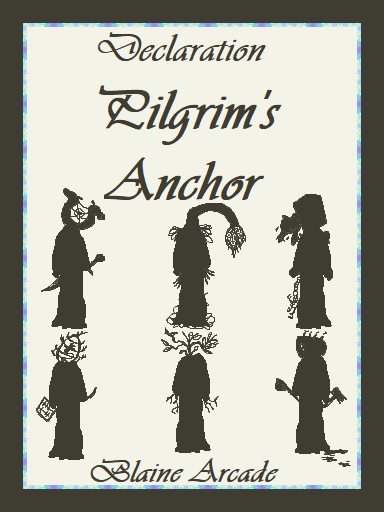
pilgrimsanchorcover

Declaration

Pilgrim’s Anchor

by

Blaine Arcade

From the Unintended Declaration of Independence from the Earth

When in the Course of human events, it becomes necessary for one people to dissolve the political bands which have connected them with another, and to assume among the powers of the earth, the separate and equal station to which the Laws of Nature and of Nature’s God entitle them, a decent respect to the opinions of mankind requires that they should declare the causes which impel them to the separation.

We hold these truths to be self-evident, that all men are created equal, that they are endowed by their Creator with certain unalienable Rights, that among these are Life, Liberty and the pursuit of Happiness.–That to secure these rights, Governments are instituted among Men, deriving their just powers from the consent of the governed, –That whenever any Form of Government becomes destructive of these ends, it is the Right of the People to alter or to abolish it, and to institute new Government, laying its foundation on such principles and organizing its powers in such form, as to them shall seem most likely to effect their Safety and Happiness.

Prudence, indeed, will dictate that Governments long established should not be changed for light and transient causes; and accordingly all experience hath shewn, that mankind are more disposed to suffer, while evils are sufferable, than to right themselves by abolishing the forms to which they are accustomed. But when a long train of abuses and usurpations, pursuing invariably the same Object evinces a design to reduce them under absolute Despotism, it is their right, it is their duty, to throw off such Government, and to provide new Guards for their future security.

From the Pilgrim’s Anchor Charter

Just as man has found himself on foreign shores and learned of their alien men, so too can he be faced with aliened and remote concepts. Every mind can thus be unfurled and read as a map, however daunting traversal may threaten itself to be through unfamiliar rivers and mountain ranges.

So it is that we find ourselves exploring a new mind, and in so doing disturbing its daily thought, bringing to it nightmares in dream and daylight alike. In order to found a tranquil mutual existence where respect bridges the gap of continental minds we must explore, and disturb, and trespass. All is so done in the earnest hope that peoples differing can be made to understand each other.

Here it is declared, and taken as fated and patient understanding, that any strife thus caused cannot be held in accounts vengeful, brought as a grievance of compounded cultural interest only to those who have adjusted to the course of history. —That where a pilgrim has dropped anchor is not where he has dealt injury, and that a world discovered is a world claimed, and that all living things are entitled to learn, disturb, and sow as they test the boundaries of freedom. Continue reading

Planet in Theory: Riverboat Without a Captain (Finale)

(back to part one)

(estimated reading time: 1 hour, 17 minutes)

November 7th

2008

Our Nemesis

The artist’s retreat was over, and most of the last weren’t worth saying goodbye to. Long Odd Silver only sought out one of them, not meaning any offense to the rest of her band of course; it was just that none of them other than their lead singer had spoken a word the entire time. Perhaps she was the only one who could.

How the artists left was never actually witnessed, with the passengers assuming they vanished when there was nobody to observe them, as often happened with things in probable space that were either unsure of themselves or too sure of one aspect of themselves. Roxy Clink was likely the latter. Continue reading

Planet in Theory: Riverboat Without a Captain (part four)

(back to part one)

(estimated reading time: 51 minutes)

October 13th

2008

Plunge

The window’s getting tight now. Not much year left in our year long voyage. It’s clear what Dry and Roman want: the 1to1. They’re still looking forward to the regularly scheduled programming. But what about Sonny? He’s still here even though his vengeance is complete and there’s nobody to wed.

He has plenty of artists to choose from still, but says they’re not his type. That means they’re not our type, that they won’t fill the captain’s shoes unless they trip into them. That’s not their purpose here, so it still belongs to a passenger. Continue reading

Planet in Theory: Riverboat Without a Captain (part three)

(back to part one)

(estimated reading time: 1 hour, 34 minutes)

September 22nd

2007

Tell the Ice Floes to Hold that Pose

The chill in the air had less to do with the time of year and more to do with the waters they had entered: Rivulet M14. At times across the year they had seen other ships passing, many of whom signaled them with flashing lights and flares, their crews and passengers practically hanging over the side as they waved. There were likely radio broadcasts as well, but the Viper True made sure no machine aboard received them.

Sometimes someone on another vessel saw it as their only chance to interact with the legendary ship, jumping overboard and attempting to swim the distance. They never made it, and though the Viper True’s pace was too swift to tell, Silver doubted they all made it back to their original vessels either. Continue reading

Planet in Theory: Riverboat Without a Captain (part two)

(back to part one)

(estimated reading time: 1 hour, 30 minutes)

November 7th

2007

Big Shoes to Fill

And just what do you think you’re doing here!?” a woman in a scarlet coat asked. Her thin gloves were just as red, and so were her painted lips. Her heavy coat had a hood lined with what looked like the fur of a snow leopard, each spot the number 2. If it actually came from an animal that meant its odds at the time of death had been 2to1, and people like her wouldn’t dare wear anything more likely than themselves, so she must have been that close to reality as well.

She had dark darting eyes like panicking tadpoles and a stance that suggested she would try to repel a mudslide with pure indignation rather than flee from it. Her glossy brown hair was done up in a frazzle like an electrical cable chewed on by a raccoon. Roman recognized her voice, and by the slight chill in her pallor he guessed she had been on that iceberg no more than 3 hours ago. Continue reading

Planet in Theory: Riverboat Without a Captain (part one)

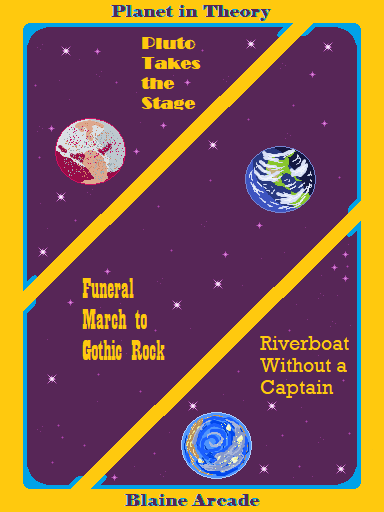
In 2006 poor Pluto suffered a demotion, from planet to dwarf planet, unwittingly causing a version of it to appear in probable space: the realm of planets that were only ever theorized and people who have to track their own likelihood as much as their food and water intake.  Pluto arrived with a full population of adults, suddenly responsible for their own lives, and thus began the Planet in Theory series.

In Pluto Takes the Stage we covered its crashing the party, and from there journeyed to the theorized counter-Earth Antichthon and dealt with its many ghosts in Funeral March to Gothic Rock.  Now we follow the wild 8to1 scoundrel Long Odd Silver and the former prince of Pluto as they crash-land on Vulcan, likeliest of theorized worlds, and right to the deck of an autonomous ship crewed by a handful of the shiftiest figures who all share the same goal.  They say the ship is headed to the 1to1, back to the reality Pluto dropped out of…

(estimated reading time for part one: 1 hour)

(estimated reading time for entire novel: 6 hours, 12 minutes)

Planet in Theory

Riverboat without a Captain

by

Blaine Arcade

November 7th

2007

Not Much Spit Left

Over 3,000,000,000 lonely miles separated Earth from Pluto. The dwarf planet was too far from the sun to have much of a bright side, but it hoped for one nonetheless when it was demoted, knocked out of the solar 9 like a back row billiard ball, held responsible for impacts several spheres away.

No longer a planet, but perhaps in a friendlier neighborhood? Only in the sense that it was emptier, so there were fewer threats to come screaming out of the darkness and smash into it. The people that had the privilege of existing went on, after an all too brief bout of complaining over Pluto’s loss, talking about all the other planets, how they were feeling, whether they were in retrograde, never to collectively turn their minds back to the downgrade. Continue reading

Planet in Theory: Funeral March to Gothic Rock (finale)

(back to part one)

(reading time: 1 hour, 17 minutes)

Under the Hood

The Drymouth Desert was deceptively small. A person on foot would claim it an endless sea of inhospitable madness, where sand dunes atop red clay occasionally lurched forward to eat tumbletrees, which were the only available prey. It would be the last claim that person would make before their voice was baked out of them and they were heat-blasted into a strip of anxious and peeved leather.

The issue was the lack of perspective, much like Silver and Roman needing to seek higher ground in the bear trap to get the lay of the land. The dunes were too high for a person on foot to see over, so natural odds-confounding forces got them turned around, had them walking in circles until their final quarter circle. Continue reading

Planet in Theory: Funeral March to Gothic Rock (part four)

(back to part one)

(reading time: 1 hour, 7 minutes)

Bill at the Door

It was still Halloween morning and he was already bored of darts. Bill knew his people were letting him win. Even the ones who wouldn’t normally were coddling him that day. Halloween was when the Billity family got scared, always expecting someone possessed by a ghostly mask to come to the door and seek bloody revenge.

Some of his relatives had even been offended when no such specters came calling, thinking they must not have sent the message properly if those wronged had still managed to find rest. Continue reading