The signing of the United States Declaration of Independence… has gone awry! As it so happens the declaration was too powerfully worded, and effectively declared independence from the realm of Earth. The signing founders, and those legally considered their property, and a Native American tribe roped in as well thanks to an old treaty, have been transported to a strange new land where trees write upon their own leaves and owl-eyed worms march about in the shapes of men.
Twenty years on the Founders are desperate to return to the war they never started, and have enlisted their mixed-heritage children as an army to help them fight the Bickyplots: thirteen shambling horrors with colonial inspirations of their own. Here the written word is magic, and a new declaration might undo everything, but what of the children who have fought and journaled so hard to build their own lives? Find out in this, the first of the Declaration duology.
(estimated reading time: 1 hour, 16 minutes)
(estimated reading time for entire novel: 6 hours)
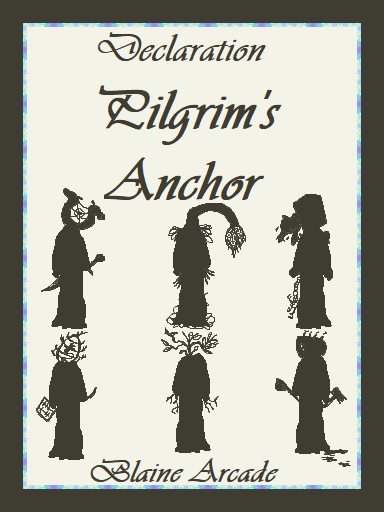
Declaration
Pilgrim’s Anchor
by
Blaine Arcade
From the Unintended Declaration of Independence from the Earth
When in the Course of human events, it becomes necessary for one people to dissolve the political bands which have connected them with another, and to assume among the powers of the earth, the separate and equal station to which the Laws of Nature and of Nature’s God entitle them, a decent respect to the opinions of mankind requires that they should declare the causes which impel them to the separation.
We hold these truths to be self-evident, that all men are created equal, that they are endowed by their Creator with certain unalienable Rights, that among these are Life, Liberty and the pursuit of Happiness.–That to secure these rights, Governments are instituted among Men, deriving their just powers from the consent of the governed, –That whenever any Form of Government becomes destructive of these ends, it is the Right of the People to alter or to abolish it, and to institute new Government, laying its foundation on such principles and organizing its powers in such form, as to them shall seem most likely to effect their Safety and Happiness.
Prudence, indeed, will dictate that Governments long established should not be changed for light and transient causes; and accordingly all experience hath shewn, that mankind are more disposed to suffer, while evils are sufferable, than to right themselves by abolishing the forms to which they are accustomed. But when a long train of abuses and usurpations, pursuing invariably the same Object evinces a design to reduce them under absolute Despotism, it is their right, it is their duty, to throw off such Government, and to provide new Guards for their future security.
From the Pilgrim’s Anchor Charter
Just as man has found himself on foreign shores and learned of their alien men, so too can he be faced with aliened and remote concepts. Every mind can thus be unfurled and read as a map, however daunting traversal may threaten itself to be through unfamiliar rivers and mountain ranges.
So it is that we find ourselves exploring a new mind, and in so doing disturbing its daily thought, bringing to it nightmares in dream and daylight alike. In order to found a tranquil mutual existence where respect bridges the gap of continental minds we must explore, and disturb, and trespass. All is so done in the earnest hope that peoples differing can be made to understand each other.
Here it is declared, and taken as fated and patient understanding, that any strife thus caused cannot be held in accounts vengeful, brought as a grievance of compounded cultural interest only to those who have adjusted to the course of history. —That where a pilgrim has dropped anchor is not where he has dealt injury, and that a world discovered is a world claimed, and that all living things are entitled to learn, disturb, and sow as they test the boundaries of freedom. Continue reading →

 Blaine Arcade