One man has reformulated the primordial soup, opening countless possibilities as he keeps the secret recipe to himself. It animates his robots, who swarm into industry and build lives of their own. It enlightens the animals, who are granted citizenship! It turns humans into indestructible floating heads pondering the universe.
The tributaries of revolutionizing soup converge in Iron Baltimore, city of futures bright and dim, where lives the world’s only hyperdiamond manufacturer, the artist known as Al Grand whose own invention, when loaded into a popgun, can destroy a robot’s crystal brain in a single blow. But he doesn’t sell, and he won’t tell. Everyone’s got it out for him, and one of them has broken in and left a slimy gift in his apartment…
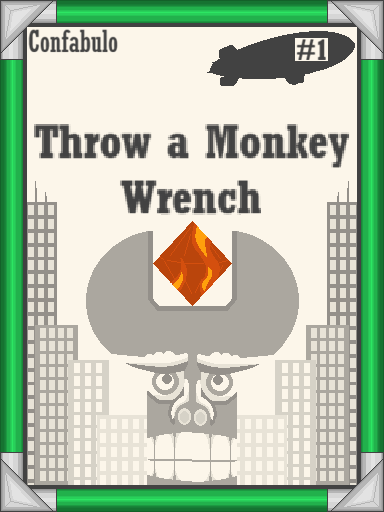
Throw a Monkey Wrench is the first novel in a Wizard-of-Ozian dieselpunk series of five!
(estimated reading time: 1 hour, 12 minutes)
Confabulo
Throw a Monkey Wrench
by
Blaine Arcade
Dress Up with Nowhere to Go
Figures so unlike their lazy scarecrow cousins were strewn across the half-planted fields. Rusty and plain, riveted at left and right, they were bent and frozen mid-labors with hoes, spades, rakes, and watering cans. Round eyes of ribbed ochre glass were dark as the night, poised to borrow the day.
The first rays of morning crested a distant hill, shot into their midst and struck one of the figures on the chest. A stream resumed, as the watering can they held tilted imperceptibly. More light fired across the land, found purchase in their pitted metal and nesting rust. A hoe struck. A rake dragged.
As seeds dropped into divots squeaking steps made more mere feet away. The metal workers came to life, no need for breakfast or stretches. Not a single dream had broken the sequence of their tasks, as their minds could not take them anywhere without their permission or his.
For them it was as if the night had never occurred, as if stillness never occurred. Their entire existence was active experience, perpetual transportation of body, thought, and emotion, caught in currents that required adaptation. When the currents slowed so did they, and when the currents sped they made history much faster than humans were used to.
The morning didn’t stop there; it kept on out of the farmlands where things only grew yea high and on to the city where they grew until the tallest one toppled. Dawn’s artillery on those walls of glass, concrete, brick, iron, and brass was weaker than breath, for this was Iron Baltimore. Its industry was moved by figures well-adapted, ever-present. One fed the other. The leaking weaknesses of previous perpetual motion machines were patched by the constant influx of human demand, of their mean-spirited and flirtatious pushing, and of their emanating incandescent body heat, like blankets tossed out of windows drifting to the street. Iron Baltimore was swaddled with energy. Continue reading →

 Blaine Arcade