Bubcap & Brackray

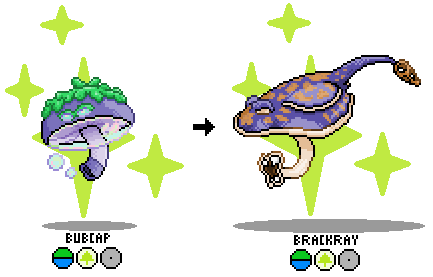
Bubcap & Brackray

Designation: the PSATHYRELLA AQUATICA cillimorphs

Group: GROWER

Native Biomes: PLANET SPLISHY & PLANET WOODZY

Size: SMALL

Interesting Facts: Bubcap uses the bubble under its gills and its snorkel tail to hang in the middle of the water so it never has to surface and say the morph equivalent of ‘Polo’ in games of Marco Polo. This activity is estimated to take up 73% of all amphibious wild cillimorphs’ free time. Brackray picks up food off the bottom as it cruises with its stalk-mouth, which makes an alright pogo stick on land.

Previous Cillimorphs

Field Guide Intro

Next Cillimorphs

Pinberg & Mastodontist

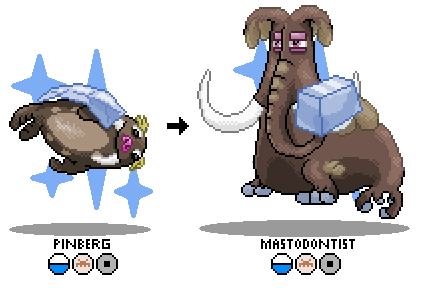
Pinberg & Mastodontist

Designation: the ODOBENOCETOPS & ELEPHANT SEAL cillimorphs

Group: MAMMALISH

Native Biomes: PLANET BRRR & PLANET SPLISHY

Size: MEDIUM

Interesting Facts: Pinberg augments its bigger tusk with an icy sheath; it leaps out of the water in an arc to show off both of them. Mastodontist exchanges the sheath for an ice cube hammer on its trunk, which it uses to strike its tusks like bells and make music. It’s alright, not really my scene. I’m more of a ska guy.

Previous Cillimorphs

Cillimorph Basics

Next Cillimorphs

Millistone & Millidozer

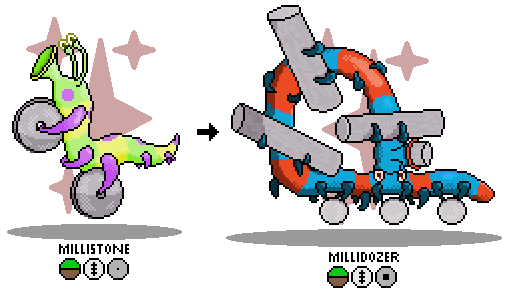
Millistone & Millidozer

Designation: the MILLSTONE & ROLLER cillimorphs

Group: SEGMENTED

Native Biomes: PLANET WOODZY & PLANET BOLDERO

Size: SMALL & MEDIUM

Interesting Facts: These dudes use their goofy funnel mouths to mix spit and grit and make means of transportation, mostly wheels and rollers. You’ll want to hang out with them when they’ve got rocks stuck in their mouths, because when they don’t they’re always trumpeting stupid little jingles that get stuck in your head.

Previous Cillimorphs

Cillimorph Basics

Next Cillimorphs

Geovum & Clusterukh

Geovum&Clusterukh

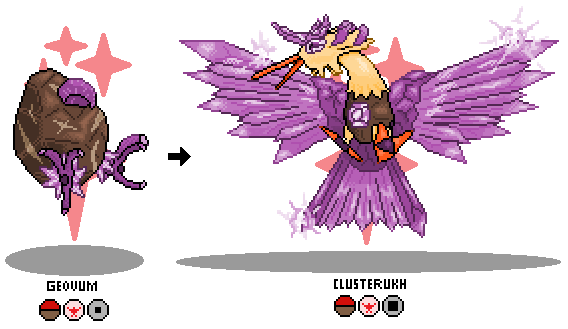
Geovum & Clusterukh

Designation: the GEODE & RUKH cillimorphs

Group: BIRDISH

Native Biomes: PLANET SCORCHER & PLANET BOLDERO

Size: MEDIUM & LARGE

Interesting Facts: Geovum is only partly hatched out of its stony egg, and it’s in no hurry, because the interior of its shell is filled with glittering amethyst. Now, there’s no light inside the egg either, but it can still see the crystals, thanks to all the background silliness that takes care of any and all plot holes to do with cillimorphs. They’re just silly little guys, what do they need reason for?

Oh and Clusterukh is pretty big and pretty rigid. It makes flying in caverns difficult… for the cavern walls.

Previous Cillimorphs

Cillimorphs Basics

Next Cillimorphs

Guzzjar & Swauldron

Guzzjar & Swauldron

Designation: the NIGHTJAR cillimorphs

Group: BIRDISH

Native Biomes: PLANET WOODZY

Size: SMALL

Interesting Facts: Guzzjar is constantly gargling all the guzz it generates. What is guzz? I don’t have enough of an iron stomach to describe it in detail. You wouldn’t want it on a sandwich, I’ll tell you that. Swauldron has way more guzz, and it sloshes and spills as it flies.

Previous Cillimorphs

Cillimorph Basics

Next Cillimorphs

Flicflam & Wheeleo

Flicflam & Wheeleo

Designation: the FLICFLAC SPIDER & GOLDEN WHEEL SPIDER cillimorphs

Group: SEGMENTED

Native Biomes: PLANET SCORCHER

Size: SMALL

Interesting Facts: Flicflam flips itself across hot sand dunes like a coin, except it always lands on heads. This helps keep its feet cool. The darker side tends to be upright at night. Wheeleo rolls around in a wheel of fire, disguising its spiderish body as a ferocious lion face, hoping we’re all such dumdums we won’t know there isn’t a lion body anywhere in the vicinity.

Previous Cillimorphs

Cillimorphs Basics

Next Cillimorphs

Corbor & Frozempole

Corbor & Frozempole

Designation: the ICE CORE & TOTEM POLE cillimorphs

Group: COLONIAL

Native Biomes: PLANET BRRR

Size: SMALL & MEDIUM

Interesting Facts: Corbor delves deep into ice shelves to see what it can find, mostly horrors that lead to its lower faces becoming angrier and more cynical. The top ones are more fun to hang with. Once it matures into Frozempole the sections gain some independence, but they always come back together when they’re done screwing around.

Previous Cillimorphs

Cillimorphs Basics

Next Cillimorphs

Germalite & Bloomcast

Germalite & Bloomcast

Designation: the SPACE SEED & SATELLITE DISH cillimorphs

Group: GROWER

Native Biomes: OUTER SPACE & PLANET WOODZY

Size: SMALL & MEDIUM

Interesting Facts: Germalite hangs out in space, turning solar radiation into rocket fuel and food for the plasma sprouts it grows on its ring. When it’s ready to mature it descends to the wooded planet and gains a much more couch potato-y form. Bloomcast uses its flower to send messages deep into space, telling Germalites about good places to bum around for the rest of their lives.

Previous Cillimorphs

Cillimorphs Basics

Next Cillimorphs

Cillimorphs Field Guide

Cillimorphs

a creature-collecting universe

&

field guide

by

Blaine Arcade

What is a cillimorph anyway, huh smart guy??


A cillimorph is an organism created from a combination of organisms, objects, and concepts found on the defunct planet E-A-R-T-H, pronounced ‘urth’ for some reason and not ‘ear-th’, like you’re saying ‘ears’ with a lisp.

Anyway, you can’t just make a cillimorph with hopes, dreams, and sub-light speed engines, which was pretty much all those cave goobers had when they left that planet with a dumb name after absolutely trashing the place in a major rager called consumerism. What you need is a crystal of this stuff, cillium: Continue reading