
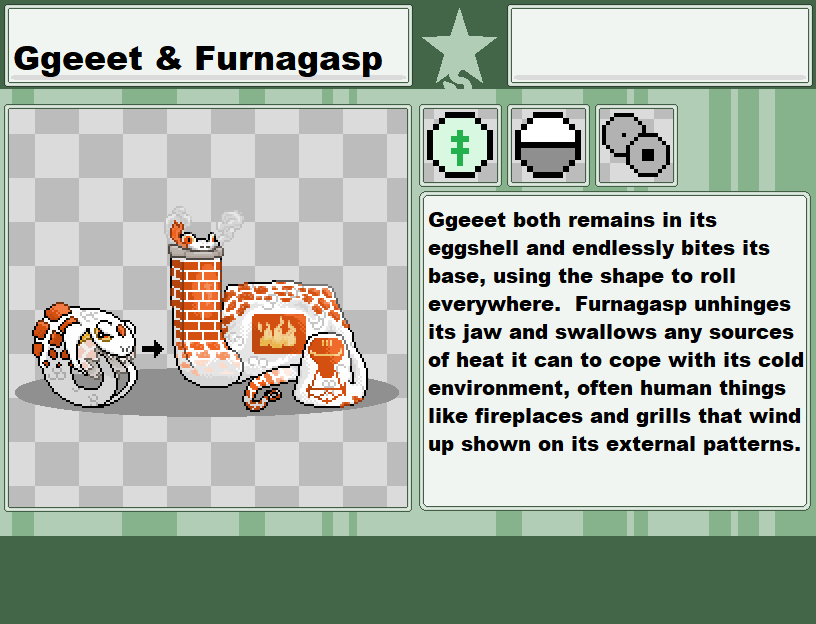
Ggeeet & Furnagasp
Designation: the EGG EATER SNAKE & CHIMNEY cillimorphs
Group: REPTOPHIBIAN
Native Biomes: PLANET BRRR & PLANET URBANIAK
Size: SMALL & MEDIUM
Ggeeet & Furnagasp
Designation: the EGG EATER SNAKE & CHIMNEY cillimorphs
Group: REPTOPHIBIAN
Native Biomes: PLANET BRRR & PLANET URBANIAK
Size: SMALL & MEDIUM

Clacklaw & Lynxball
Designation: the CAT EYE MARBLE cillimorphs
Group: SPINELESS
Native Biomes: PLANET WOODZY & PLANET BRRR
Size: SMALL
Interesting Facts: Clacklaw and Lynxball have worm-like bodies that have become so stunted they are spherical. Excretions freeze into a glass-like shell to aid in rolling locomotion, and they can also use them like prisms to redirect energy into attacks and, in Lynxball’s case, goofy ear-paw projections.

Burgulp & Lungrand
Designation: the LUNGFISH cillimorphs
Group: FISHY
Native Biomes: PLANET WOODZY & PLANET SCORCHER
Size: SMALL & MEDIUM
Interesting Facts: Burgulp encases itself in slime and buries itself deep underground whenever there’s a drought, sometimes not emerging until after it has matured into Lungrand, which produces bigger more beautiful bubbles and leaps out of the water energetically in high-oxygen environments.

Crumf & Labrytaur
Designation: the BREADCRUMB TRAIL & MINOTAUR cillimorphs
Group: MAMMALISH
Native Biomes: PLANET SCORCHER & PLANET BOLDERO
Size: SMALL & MEDIUM
Interesting Facts: Haughty little Crumf’s silliness field has mutated a plant into a symbiotic nose ring bread-berry that constantly drops crumbs so it never loses its way. It drops off as an adult, which is now mature enough to use its tail fibers for trails and the rearranging map on its chest as it navigates the tunnels and labyrinths it builds and guards.
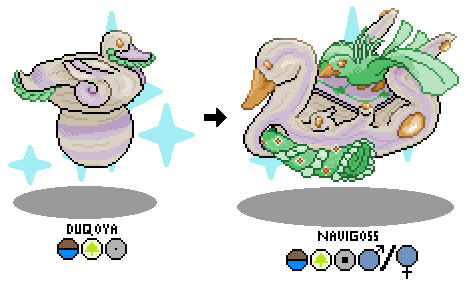
Duqoya & Navigoss
Designation: the DUCK DECOY & HELIPAD cillimorphs
Group: GROWER
Native Biomes: PLANET BOLDERO & PLANET SPLISHY
Size: SMALL & MEDIUM
Interesting Facts: Buoyed by a hollow sphere of wood, Duqoya hangs out with waterfowlish morphs despite its awkward silence. Maturing into Navigoss splits it into two parts: a home base female and a flying male adapted to maximize reproductive opportunities.
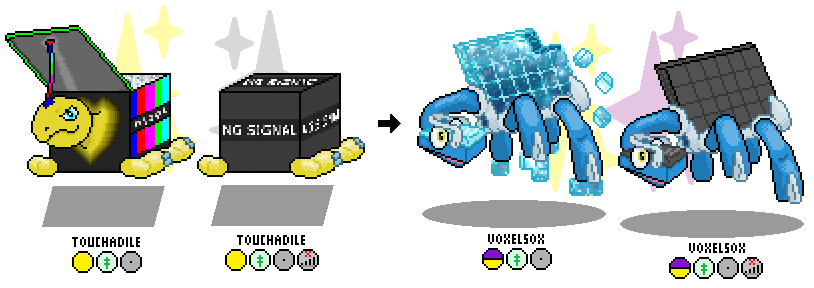
Touchadile & Voxelsox
Designation: the BOX TURTLE & VOXEL cillimorphs
Group: REPTOPHIBIAN
Native Biomes: CYBERSPACE & OUTER SPACE
Size: SMALL
Interesting Facts: Touchadile can watch six different signals on its interior screens, which others can watch from the outside. Sometimes its head stays locked away for years at a time, rarely even changing the channel. Voxelsox can disassemble its shell into cubes that can be endlessly rearranged.

Silcraft & Lunafroth
Designation: the CORACLE & LUNAR MOTH cillimorphs
Group: SEGMENTED
Native Biomes: PLANET SPLISHY & OUTER SPACE
Size: SMALL
Interesting Facts: Silcraft weaves its own coracle and paddle to traverse great expanses, rarely looking away from various moons. As an imago its both its wing shape and the power of its gravity-altering tidal wing beats are affected by the phases of its favorite moon.
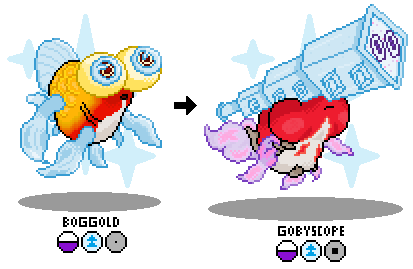
Boggold & Gobyscope
Designation: the BUBBLE-EYE GOLDFISH & WATER TELESCOPE cillimorphs
Group: FISHY
Native Biomes: PLANET BRRR & OUTER SPACE
Size: SMALL & MEDIUM
Interesting Facts: Boggold’s big eyes are further enhanced by a pair of icy contact lenses, giving it the power to look out from the waters of Brrr to see if it wants to go anywhere in particular in space, or vice versa. Gobyscope’s lenses are upgraded to an ice telescope with a water lens that can see outside the system, but it’s so heavy that it often lists to one side and sends the morph rolling.
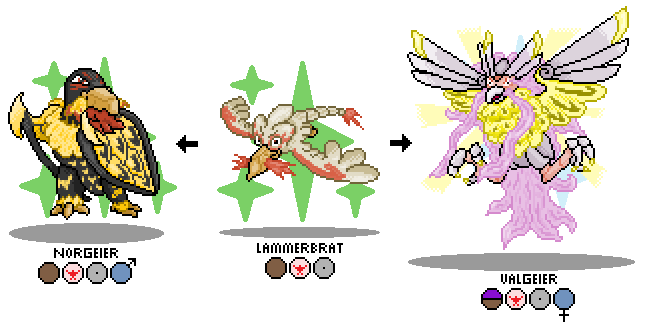
Lammerbrat, Norgeier, & Valgeier
Designation: the LAMMERGEIER, VIKING, & VALKYRIE cillimorphs
Group: BIRDISH
Native Biomes: PLANET BOLDERO & OUTER SPACE
Size: SMALL
Interesting Facts: The adults have complementary roles in their sexual dimorphism, with Norgeier shaping their wings and feathers into axes and shields for territorial battles. When they get too tired, a Valgeier descends from space and whisks them away to a place of recovery.

Boneclubba & Bonecutta
Designation: the CUTTLE BONE cillimorphs
Group: Spineless
Native Biomes: PLANET SCORCHER & OUTER SPACE
Size: SMALL & MEDIUM
Interesting Facts: Boneclubba’s bony shell allows it to go inert outside of water and in extreme temperatures for long periods. Bonecuttas figure out how to convert it into reaping blades, but don’t have much to cut in space or the desert, so sometimes they’re seen chasing around frightened grower morphs trying to give them a haircut.

